


CFOs of private-equity-backed companies are putting a higher priority on growth than their publicly listed counterparts and are doing so with greater urgency and focus, much like their CEOs.
These executives emphasize revenue growth and acquisitions as their top priorities for creating shareholder value, in stark contrast with their public-company peers. They are also looking for strategic fit and quick payback when considering where to deploy capital rather than the financial metrics, such as return on invested capital, favored by finance chiefs of public companies.
Cost management, a traditional strength of PE-owned firms, remains a high priority but not an overriding one, unlike for public-company CFOs.
These priorities, which emerge from a breakdown of survey results from the Oliver Wyman Forum’s CFO Agenda 2026, reveal how CFOs are becoming the architects of inorganic growth and value realization for PE-owned companies. They appear keenly aware of the pace and urgency of today’s operating environment, using levers they directly control to pursue growth initiatives that can pay off quickly. It’s an approach that’s practically tailor-made for today’s higher-interest-rate climate and a global equity market that rewards firms that can turn technology disruption into faster growth trajectories.
Deals and revenue growth reshape the PE-backed CFO playbook
More than three-quarters of PE CFOs surveyed (77%) selected a growth lever as their top priority for increasing shareholder value in the next one to two years, compared with 61% of CFOs of public companies. That’s a stronger growth tilt than the survey revealed among PE chief executives (75% versus 70% for their public peers).
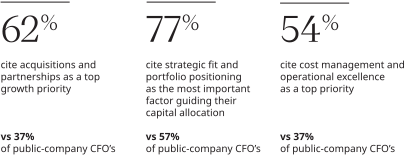
The detail is also telling. Acquisitions and partnerships stand out as the most popular growth lever, with 62% of PE-backed CFOs citing it as one of their top three priorities, compared with just 37% of their public counterparts (and 41% of their own CEOs). This divergence in appetite for inorganic growth is the widest in the survey, and for good reason. With these companies typically held for roughly five years by their private equity owners, deals can be appealing as a means of boosting growth quickly, expanding the total addressable market, and generating cost synergies, thereby enhancing exit multiples.
Revenue uplift ranks equally high, with 61% of the PE cohort citing it as a priority and 34% making it their top priority, compared with 45% and 26%, respectively, among their public peers. The pattern reverses for returning capital to shareholders, at 9% versus 23%.
PE CFOs also place somewhat less emphasis on cost management and operational excellence than public CFOs do. A little over half (54%) cite it among their top three priorities, but only 9% rank it No. 1; the comparable figures for public CFOs are 59% and 12%, respectively.
These figures suggest a twist to the traditional PE operating model, with cost discipline significant but largely table stakes for expanding margins as CFOs look more to deals and revenue growth to generate bigger gains. Revenue growth accounted for 71% of value creation in private equity investments in 2024, up from 43% five years earlier and displacing expanded price-to-earnings multiples as the leading driver of value creation.
Private equity CFOs demand stronger ROI from AI investments
As artificial intelligence rises to the top of the C-suite agenda, the survey reveals an interesting nuance: The big difference in attitudes isn’t between private equity firms and public companies but between PE CFOs and their bosses.
PE-backed finance chiefs are on the same page as their public counterparts on prioritizing technology and AI deployment (both at 37%), but they lag behind PE CEOs, who exhibit a stronger tech and AI tilt than their public peers (49% versus 35%). This may reflect a particularly rigorous approach by PE CFOs to make sure that AI investments can generate demonstrable returns in the near term.
PE CFOs lag their public counterparts in planning or starting to deploy AI in many areas, including planning, forecasting, and scenario modeling (78% versus 84%), and controls, audit, fraud detection, and risk management (56% versus 79%). Yet they agree on which way the wind is blowing, with both cohorts ranking AI, digital, and data transformation among the top three forces driving change in their role (67% and 69%, respectively). And PE finance chiefs are more likely than their public peers to expect finance to play a bigger role in shaping and governing the firm’s technology and AI initiatives going forward (41% versus 35%).
How private equity CFOs balance strategic fit and cash flow
PE-backed CFOs take a distinctly different approach to allocating capital than their public peers, one that also reflects their ownership model. They are much more likely to focus on strategic fit, portfolio positioning, and business and geographic diversification (77% versus 57%) and twice as likely to emphasize payback period and cash flow profile (48% versus 24%). By contrast, public company CFOs place much greater weight on metrics such as return on invested capital (62% versus 44%) and cost of capital and hurdle rates (21% versus 10%).
The results underscore the fact that the relatively short holding periods of private equity owners put a premium on the ability of CFOs to create value in cash flow and earnings in the near term.
Why customer trends and profit margins matter to private equity CFOs
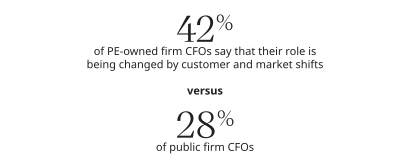
PE CFOs view their role through a micro lens rather than a macro one, focusing their energies on levers they can influence. They are much more likely than their public-company counterparts to cite customer and market shifts as a leading driver of change in their role (42% versus 28%) and much less likely to cite macroeconomic and geopolitical volatility (23% versus 46%).
They also are more likely to expect the finance function to increase its role in driving cost, productivity, and margin improvement (78% versus 66%), and more likely to cite providing advanced analytics and scenario modeling for strategic decisions as their No. 1 growth area (30% versus 23%). Investor relations is a different matter. PE CFOs are much less likely than their public company counterparts to prioritize shaping the investor and stakeholder narrative (43% versus 73%).
Three lessons every CFO can learn from private equity firms
Ownership structure clearly influences how CFOs approach their roles, and survey results reveal striking differences. PE-backed CFOs place a greater emphasis on growth than their public company peers, but they’re also working against a much tighter timeline. With an exit typically five years out, investments need to deliver measurable results sooner rather than later.
That urgency comes through in the findings. PE-backed CFOs prioritize initiatives that can deliver near-term earnings improvements, generate cash, and produce results within management’s control.
Public company CFOs operate under different conditions. They have longer investment horizons, a broader investor base, and more stakeholders to answer to. While the PE model may not translate directly, there's something to be said for bringing the same discipline and sense of urgency to financial decision-making.
For CFOs looking to take a page from the PE playbook, a few priorities stand out:
- Be aggressive about growth. Look for opportunities to expand through acquisitions and increase revenue within the existing business.
- Hold investments to a high standard. Evaluate how quickly they can generate returns and contribute to cash flow.
- Concentrate on what management can control. Prioritize improvements in margins and productivity, along with more disciplined capital allocation.
PE-backed CFOs have a limited window to prove their impact, and they operate accordingly. Every investment, resource allocation decision and performance target is tied to delivering measurable value. CFOs across all ownership structures would do well to bring that same urgency and accountability to the role.
