


Executives know what's holding back their transformations. They're just not focusing on the solution.
The stakes of that disconnect are rising fast. In our 2026 Global Performance Transformation Survey, executives say they are betting more than a third of their 2027 performance gains on AI, with boards measuring results on a 12-month timeline. And companies already spend $2 for every $1 of annual benefit their transformations return, even though spending more doesn’t improve outcomes.
The survey data reveal a simple pattern to what does improve them: The companies that succeed align their organizations with their strategies, develop the talent to execute them, and rethink how work gets done. For leaders grappling with how to turn ambitious plans into measurable results, the findings below offer a powerful clue about where to focus next.
Why talent and organizational gaps hold back business transformation
The C-suite is remarkably clear about what prevents transformations from delivering their full potential. Eight in 10 rank talent and capability gaps among their three biggest barriers to success, and a third rank them as the top barrier. Yet 45% of these same leaders rank technology, data, and AI as their No. 1 priority for 2027 and beyond. Just 7% put the organization — structure and accountabilities, talent, and workforce models — at the top of their lists.
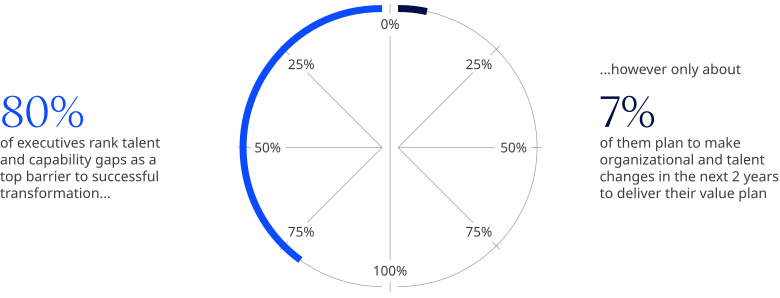
What accounts for this disconnect? One possible explanation is what we call the initiative bias. Technology programs and strategic initiatives come with defined budgets, implementation plans, milestones, and accountable project owners, so they’re highly visible and relatively easy to package for investment decisions. Changing the organization, however, requires developing new capabilities, redesigning how work gets done, and challenging established decision rights.
These moves often cut across functions, making them harder to define, fund, and govern as discrete investments. As a result, the initiative gets an explicit business case, while the organizational changes it depends on aren’t made equally clear.
Heading into 2027, the risk of initiative bias is heightening. Executives expect AI to deliver 37% of their performance gains over the next two years, well ahead of what it accounts for today. Yet redesigning work and the workforce — where those gains will be won or lost — draws just half as much effort as the technical stack.
Closing the effort gap is a start, but well-intentioned organizational changes aren't enough to remedy the problem. The right playbook executed with the wrong people still doesn't work. Alongside every major initiative, leaders should make explicit which people, processes, and organizational enablers must change, how those changes will be funded and sequenced, and who is accountable for realizing the benefits.
Aligning strategy and organization is key to driving transformation success
Nearly 90% of executives say their company is clear on how it will create value over the next three to five years, yet only 38% say those choices are tightly aligned with how the company is organized and run.
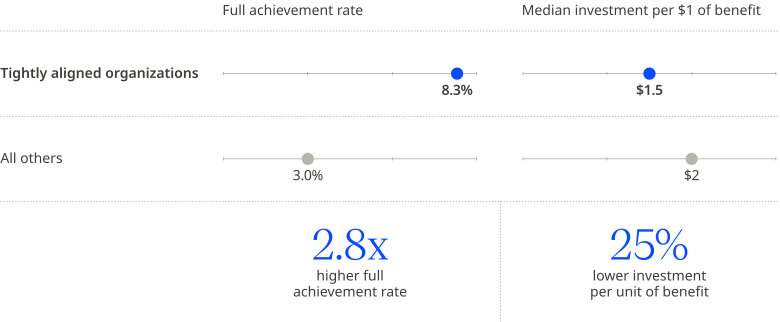
That alignment is a major differentiator: Among companies with high strategic clarity, those with tight alignment fully achieve their transformation objectives at nearly three times the rate of others, and derive benefits at roughly 25% lower cost. Alignment can’t just be bought or declared from on high. It’s a journey that takes the whole team pulling in the same direction, changing how people decide, work, and win together.
Companies fall into four camps when it comes to clarity and alignment. Those with high strategic clarity and a tightly aligned operating model make up about a third of the field. The biggest group, representing more than half of the survey sample, is clear on strategy but has not brought the operating model along. If that sounds familiar, it should — this is where most stalled transformations live. Roughly 10% report neither clarity nor alignment, and the remaining 3% meet all their transformation goals.
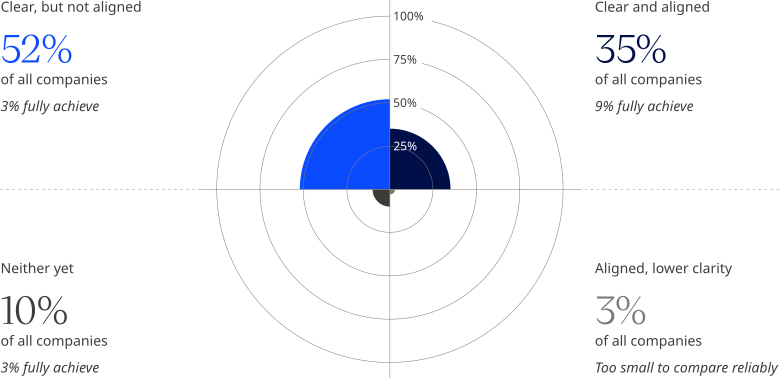
The rates at which these groups achieve their goals underscore how difficult the transformation journey is, even with the right team. Too many companies begin it before assembling one.
Treat transformation as a capability, not a program
The greatest reward from a successful transformation may be what it makes possible moving forward. Done well, it leaves a company stronger, more capable, and better equipped to tackle its next transformation. That prospect resonates with executives, with 83% ranking reinvestment in capabilities — including technology, data, operating models, and talent — among their three highest priorities for directing transformation benefits.
Companies that treat transformation as a capability to build are the ones that end up achieving the goals of their initiatives. They get completely clear on a plan to create value, align the organization to move toward it, and shift their priorities from launching initiatives to building the organization that delivers them. For leadership teams committed to long-term performance, the agenda comes down to three moves that matter:
- Hold every investment, AI included, to a visible return. The market already spends $2 for every $1 of annual benefit from a transformation, and a bigger budget buys nothing. Work out the company’s own ratio and give it an owner — and fund the transformation use case by use case, one milestone at a time.
- Put the next dollar into the organization, not another strategy. Focus on issues like decision rights, accountability, incentives, and how work gets done to achieve tight alignment, and you will triple your chances of transforming successfully.
- Fund the talent, not just the change. The team that got the company to where it is now is rarely the team that can carry it through. Identify the people the transformation actually needs, put them in the critical roles, and pay to keep them.
Get these three right, and the rewards compound: An effective transformation raises productivity, which in turn funds the next round of growth. The companies that finish successfully aren't just completing a program; they are building the organization that delivers the next one, beginning a self-sustaining cycle of successful transformation.
