


Central bank independence has traditionally been protected through institutional design. Fixed terms of office, restrictions on monetary financing, and limits on government instruction were intended to prevent political pressure from determining monetary policy. But independence is exercised through more than statutes.
Policy analysis increasingly runs on external technology platforms. Market interventions depend on commercial trading systems and real-time data. Reserve management relies on custody, messaging, and cross-border settlement infrastructure. Payment systems, supervisory surveillance, crisis coordination, and emerging AI tools add further layers of dependency.
As a result, central bank independence increasingly depends on whether the infrastructure beneath the mandate preserves freedom of action and the integrity of institutional judgment.
Why digital infrastructure is critical to central bank independence
An institution can remain formally independent while becoming practically constrained. Consider the difference between having the authority to intervene in a market and retaining the ability to do so when needed. Conducting a market operation depends on confidential strategy, timely execution, reliable market data, trading platforms, counterparties, and settlement infrastructure. Formal authority alone does not preserve independence if access to any one of those capabilities can be withdrawn for reasons unrelated to the central bank’s mandate.
The same applies to analytical integrity. An interest-rate decision may be formally free from government instruction, but its independence is weakened if the underlying data, models, or analytical tools can be accessed or altered by an external actor.
This creates a broader definition of independence: It requires not only freedom from direct instruction but also the capacity to act and reach judgments without external constraint or intervention.
Four ways technology dependencies create strategic vulnerability for central banks
External dependency does not always produce a conventional outage. Strategic vulnerability can emerge in four distinct ways. Each can affect a central bank's ability to make independent decisions, protect sensitive information, or carry out its mandate.
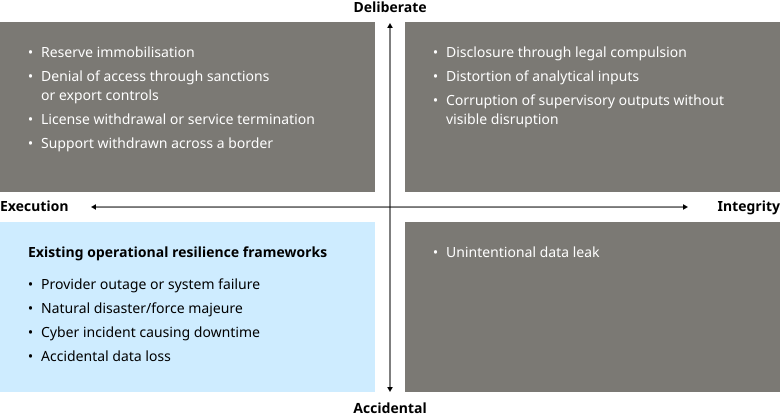
- Denial occurs when access to an asset or capability is withdrawn or made conditional, including through sanctions, export controls, licensing restrictions, or support constraints. This could affect a central bank's ability to mobilize reserves, execute market operations, maintain payment finality, or access critical cross-border messaging infrastructure.
- Disclosure occurs when confidential information becomes accessible before it is supposed to be made public. For central banks, an intervention plan, rate forecast, collateral decision, or liquidity action can be market-moving precisely because it is confidential. The same risk extends to supervisory information, policy analysis, and sensitive communications with domestic and international counterparts.
- Distortion occurs when, rather than removing access, an external actor compromises the information or tools informing a decision. The institution may continue operating without realizing that its analytical foundation has changed. This could undermine the integrity of economic analysis, macroprudential decision-making, supervisory records, or payment system oversight.
- Leverage without use may be the least visible. An institution that knows an external actor can deny access, obtain sensitive information, or influence critical inputs may adjust its behavior to avoid that intervention, even if that capability is never exercised. Such dependencies can influence decisions across monetary policy, financial stability, supervision, and payments without any visible disruption.
That means a loss of practical independence may not appear as an outage or crisis. It may appear as an option never considered, a position not taken, or a decision quietly shaped by awareness of an external dependency.
How central banks can assess execution and data integrity risks
These vulnerabilities point to two different tests of independence. The execution test asks: What must remain executable regardless of what an external party decides?
Implementing a policy decision, mobilizing reserves, maintaining payment finality, and executing market operations must remain possible even when a provider, government, or jurisdiction acts adversely. A policy decision that cannot be implemented has limited practical independence.
The integrity test asks: What must remain protected regardless of what an external party can access or how that party might act?
Pre-announcement information, models, data, policy analysis, and institutional deliberations may all require protection from external access or influence. Technical safeguards and contractual commitments matter, but they are not necessarily equivalent to sovereign control.
While many institutions already manage continuity and concentration risk, the second question — whether the integrity of information and judgment remains independent — has been less explored.
Why supplier diversification may not reduce central bank technology risks
Technology has made external dependencies deeper and harder to see. Different applications may appear to come from different vendors but they rely on the same cloud platform, data infrastructure, foundation model, operating environment, or jurisdiction underneath. Supplier diversification therefore does not necessarily equal infrastructure diversification.
The dependency stack extends well beyond the cloud. It includes critical minerals, semiconductors, hardware, connectivity, operating systems, cybersecurity tooling, AI models and applications, productivity software, payment systems, data, digital identity, and emerging quantum-related infrastructure.
These layers support monetary policy, financial stability, supervision, and payments simultaneously.
Operational resilience alone cannot protect central bank independence
Existing operational resilience frameworks provide an important foundation. They help institutions understand supplier concentration, prepare for outages, develop exit plans, and test continuity.
But strategic vulnerability asks a different question. Operational resilience typically considers whether an institution can withstand failure or disruption. Strategic vulnerability considers whether an external actor could deliberately exploit dependency through denial, disclosure, distortion, or leverage.
The distinction matters because a supplier relationship can be operationally resilient and strategically exposed at the same time.
How central banks can strengthen digital sovereignty and practical independence
Eliminating external reliance is neither realistic nor the objective. External technology markets provide capabilities that individual institutions often cannot reproduce at comparable quality.
Instead, the strategic task is to decide consciously where external reliance is acceptable, where greater assurance is required, where credible alternatives must exist, and where greater control is justified.
That elevates decisions involving technology architecture, procurement, AI adoption, cloud migration, and contract renewal beyond technical or commercial strategies. Taken together over time, they shape the institution's future freedom of action.
Likewise, the governance question is not simply who approves an individual technology contract. Central banks must know who sees the cumulative strategic vulnerability created by many individual decisions — and who has the authority to act on it.
Practical independence requires central banks to identify mandate-critical capabilities, map the dependencies and jurisdictions beneath them, establish an explicit risk appetite, and assess major technology choices as independence decisions. Ultimately, that requires governance at the level where the mandate itself is protected.

