


Policymaking is among the most fundamental functions of government, translating leadership vision and priorities into the decisions that shape society. Among members of the Gulf Cooperation Council (GCC), its importance is growing as governments link policy with national planning and transformation agendas, raising expectations for public institutions.
At the same time, artificial intelligence is creating new possibilities for how policy is developed and delivered. As AI advances from large language models toward multimodal and agentic systems, its role could expand beyond supporting discrete tasks to enabling continuous consultation and decision support across government.
Our latest paper, Rethinking Policymaking for the AI Era, argues that this development has the potential to change policymaking from a periodic and often reactive exercise to a continuous capability, enabling governments to anticipate, identify, and address issues before they develop into widespread societal challenges.
The benefits of continuous foresight in policymaking
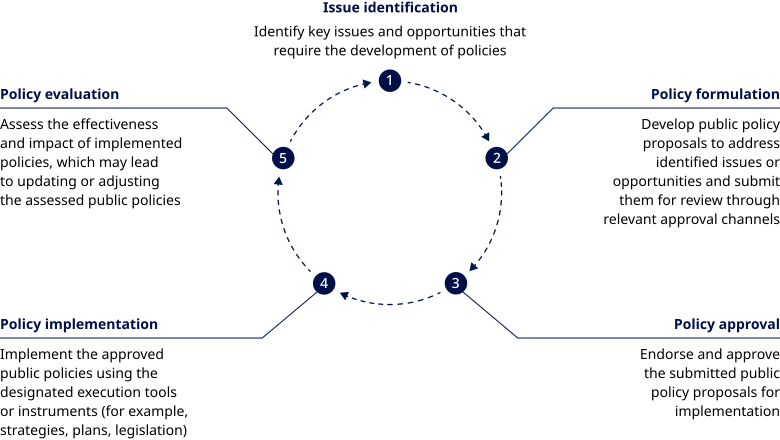
Policymaking turns government priorities into practical action — balancing leadership ambitions and long-term objectives with changing public needs. Drawing on global examples of policymaking protocols and AI modeling, our paper sets out a five-stage cycle that shows how policy moves from identifying an issue to evaluating its impact, and where AI can support each stage:
- Issue identification: Define the problem or opportunity requiring policy action.
- Policy formulation: Develop and test policy options to address the identified issue.
- Policy approval: Review and endorse the proposed policy before implementation.
- Policy implementation: Put the approved policy into practice through the appropriate mechanisms.
- Policy evaluation: Assess outcomes and feed lessons back into the next policymaking cycle.
Traditional policymaking relies on human effort and expertise throughout the process: defining the problem, gathering evidence, designing options, consulting stakeholders, and evaluating results. Used effectively, AI can automate some of the more time-consuming administrative tasks critical to the success of this approach, reducing the manual burden on policymakers so they can focus on the work that most requires human insight, judgment, and deliberation.
Beyond automation, AI can also strengthen governments' ability to identify the issues that warrant policy attention. By scanning large volumes of data, it can detect patterns that conventional analysis might miss, uncovering emerging risks and sentiment shifts, as well as early signs of social and economic change.
While forecasting and scenario modeling are already established tools in government, AI enables continuous analysis by integrating signals from real-time economic, market, and operational data and generating insights as conditions evolve.
How AI can bring new efficiency to the policy development process
Government pilots are already showing more and more rigorous, particularly in evidence review, policy consistency checks, and stakeholder input analysis.
AI can help governments analyze consultation feedback at a greater scale, identifying recurring concerns and emerging issues more quickly. In the same way, policy review can be more systematic, using AI to identify policy overlaps, contradictions, outdated provisions, and relevant precedents in minutes rather than hours.
Once a policy has been approved, AI can support how governments communicate their delivery, reshaping how citizens experience and interact with policy in their daily lives.
Evaluation and iteration can also become more continuous and evidence-based, using AI to monitor performance in real time, assess outcomes against objectives, detect unintended effects, and analyze public feedback to inform course corrections. Embedding evaluation into implementation in this way allows newly collected evidence to feed more quickly into the next round of design, helping governments respond more rapidly to changing needs and public feedback.
Human judgment must remain decisive in high-stakes decisions
As AI systems become more efficient in performing key operational tasks, one primary concern is ensuring that human judgment remains prominent in the loop while narrowing in practice. Policymakers could retain decision-making authority yet lose the ability to test the logic and implications of AI-generated recommendations themselves, weakening oversight and shifting policymaking from true human judgment toward the validation of machine outputs.
In the meantime, more immediate risks include a decreased ability to identify biased or low-quality input data, automation bias, hallucinations, and factual errors. AI-generated analysis based on poor data or inaccurate outputs can still appear rigorous, neutral, or technical while being misleading. Opaque models, data security and sovereignty risks, and the exclusion of people who lack digital access or skills also present significant challenges.
In every instance, governments need to clearly define human oversight before deploying new AI tools and ensure they are piloted in contained, low-risk policy settings. Before scaling these tools, leaders should set clear standards for how AI outputs are tested, challenged, documented, and ultimately accepted or rejected by human decision-makers.
Officials may also need to adapt existing operating models, governance structures, and decision-making processes to support the faster, more continuous policy evaluation cycles AI can enable. This means building the internal expertise to validate AI-generated analysis and recognize when human judgment should override the system.
Governments are already applying AI across policymaking, but most uses remain early-stage and narrowly scoped. Our analysis suggests that the next step for governments is to move beyond the rollout of isolated AI tools toward a more continuous AI-driven policy capability. Doing so successfully will depend on keeping human expertise, challenges, and accountability at the center of high-stakes decisions.
