


Ambition and resilience are defining Saudi Arabia’s outlook. Across the Kingdom, high levels of life satisfaction and personal confidence are creating a clear set of shared priorities: financial independence, career progression, good health, and a life that feels both stable and sustainable. Unlike in many countries where societal expectations are outpacing delivery, people in Saudi Arabia largely believe their goals remain within reach.
The Saudi edition of the Oliver Wyman Forum's 300,000 Voices study, part of a five-year global research effort spanning 20 countries and nearly 300,000 responses, reveals a society in which people are adapting enthusiastically to rapid societal change across identity, work, health, money, technology, and leadership.
Financial ambition and digital tools are driving increased investment in KSA
Security and well-being rank highest among the values people in Saudi Arabia prioritize. Seventy-one percent of respondents in Saudi Arabia say feeling safe and protected is one of the most important things in their lives, compared with 57% globally. Achievement also features prominently, with 58% saying that feeling successful matters to them. That is significantly above the global average of 40%.
Financial autonomy is a key part of this picture, and engagement with the financial markets is widespread across income levels. Thirty-eight percent of lower-income respondents in Saudi Arabia are involved in stock market investing, compared with 28% globally, while participation reaches 72% among higher earners. Long-term investment is also high, with 82% of high-income respondents and 71% of lower earners planning to continue investing over the long-term.
In 2025, 73% of respondents in Saudi Arabia used AI for financial planning, up from 51% in 2023. Two-thirds of middle- and high-income respondents believe they can achieve better returns on their own — or with AI — than through a traditional financial advisor.
Investing also remains social. Fifty-two percent cite social media as a trigger for starting or increasing their investing activity, while friends and family recommendations influence 34% of those entering the market. The result is an emerging hybrid approach among investors, favoring app-based investing and personal recommendations first, backed by customized advice from brokers and financial advisors.
Employees in Saudi Arabia seek career growth despite high job satisfaction
Employees in Saudi Arabia outperform global benchmarks on measures including job satisfaction, positive relationships with managers, and connection to company vision. Seventy-nine percent are generally satisfied with their jobs, compared with 66% globally, and 50% say they enjoy the work they do. Yet only 31% feel fulfilled at work, and fewer than one in five believe their skills are being fully used.
Across all generations, a third say they want more training, yet only 40% feel they are building the skills they need to progress. That gap between what employers offer and what employees want is most pronounced in technical skills and leadership capabilities. Both are areas people associate with long-term relevance and career advancement.
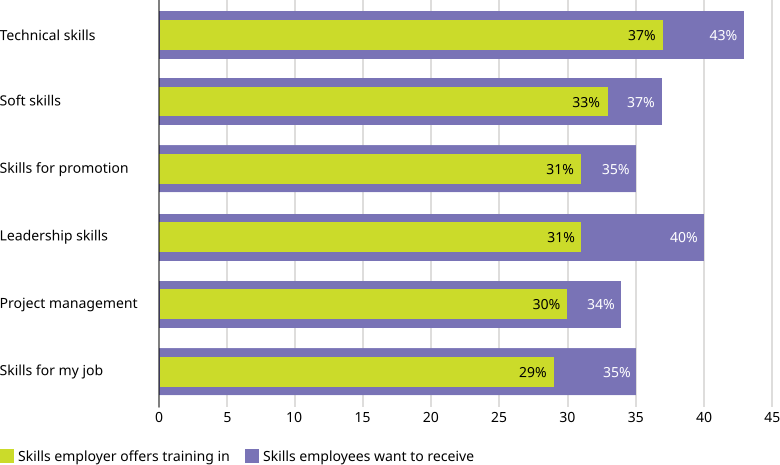
Fewer than one in five employees believe their current skill set is being fully utilized at work — a reflection of organizations failing to fully develop and deploy the talent they already have.
Employees in KSA have moved faster on AI adoption than their organizations
Today, 84% of employees in Saudi Arabia use AI at work, compared with 72% in North America and 66% in Europe. Frequent AI use, defined as three or more times a week, rose from 45% to 62% between 2023 and 2025. More than half report productivity gains and improvements to work-life balance.
Despite this, only 20% of executives in the Kingdom say their company has articulated a clear AI vision and, among non-managerial staff, that figure falls to 14%. Employees are learning by doing, sharing techniques informally, and integrating AI into their workflows ahead of formal direction.
Leadership trust remains comparatively strong: 73% of employees in Saudi Arabia are satisfied with senior leadership, versus 57% globally. But 47% want more in-person interaction with leaders, and a significant perception gap remains. While 73% of executives believe their peers display strong emotional intelligence, only 39% of non-managerial workers agree.
AI adoption rises as Saudi Arabia faces preventive healthcare gaps
Technology is also reshaping how people navigate care, with 80% of respondents using AI for health-related purposes. The Kingdom’s AI-enabled population is three times more likely to use an online symptom checker and 14% less likely to consult a primary care physician first.
More than three-quarters of people say they feel mentally well, and 62% feel physically healthy — both above the global averages of 59% and 56%, respectively. However, World Bank data show a diabetes prevalence more than double the rate of comparable developed countries, while the World Health Organization estimates the share of Saudi adults classified as overweight or obese sits at 71.8%.
This gap between perceived health and epidemiological reality presents a clear opportunity for public health strategy. People are confident, engaged, and willing to invest in their health, but they need that willingness to be matched by access to care and public health systems that support preventive behaviors and deliver lasting outcomes.
It is a picture that is repeated across the country, beyond healthcare, into the Kingdom’s consumer markets, workplaces, banks, and public institutions. In today’s Saudi Arabia, progress and ambition are high, and expectations are rising fast. People are raising their own standards in line with those expectations, and they want real returns as a result.
Saudi Arabia’s next generation of leaders must seize the opportunity set by a population with new standards across their personal and professional lives.
