


While most financial institutions have long aspired to play a bigger role in their clients’ lives, they now have a whole new level of urgency. In a recent survey of more than 400 CEOs by the Oliver Wyman Forum and the New York Stock Exchange, competitive disruption is ranked as respondents’ top opportunity and third-biggest threat.
For firms that can move from selling products and services to solving clients’ most important problems, the stakes, and the potential benefits, have never been higher. That’s thanks to a collision between three powerful forces: artificial intelligence is compressing the time it takes to assemble complex, multi-component solutions; senior buyers are consolidating vendors so they have fewer, but deeper relationships; and digital-native challengers are resetting client expectations by solving integrated problems in ways incumbents have not.
Winning this shift will require firms to develop an AI-powered intelligence layer — a “Commercial Operating System” — that makes customized, consultative solutions reproducible at scale, and turns every client engagement into institutional intelligence that compounds over time. Too many “one firm” stop at coordination rather than positioning the firm as a true solutions provider competing on client value. Solution providers command higher margins than component suppliers, generate deeper client loyalty, and occupy a seat at the strategic table that is difficult to displace.
Realizing this opportunity requires more than ambition. The shift to solutions must be backed by an operating model that can scale. Without a systematic way to assemble, replicate, and improve solutions across the client base, firms will continue to rely on exceptional individuals, and the advantage will be as portable as the people who carry it.
How solution providers move beyond product selling
To use an example, consider a wealth manager advising a family preparing for a liquidity event.
David and his co-founder are preparing to sell their privately held business and are looking for guidance on what to do with the proceeds. In the component supplier scenario, the wealth manager’s private banking team proposes a discretionary investment portfolio, while the firm’s tax and trust specialists wait to be invited in. The client is left to coordinate the pieces and often turns to external advisers to fill the gaps.
In the solution provider scenario, the wealth manager has long been engaged with David on his ownership objectives and retirement goals. They proactively convene a dedicated team spanning investment management, tax-efficient structuring, estate planning, and philanthropy, and lead a thoughtful review of options. The co-founders are on their front foot as the process begins and can negotiate their exit with an eye toward future wealth preservation. The result is a glowing reference for the wealth adviser with other privately held company founders, along with long-term rapport with David and his co-founder.
The challenges of pivoting from products to solutions
The pivot to client solutions is an execution challenge that’s equal parts mindset, organizational, and go-to-market motion. In addition, there is the challenge of scaling and institutionalizing for sustainable value.
The mindset challenge — start with the client problem, not the product portfolio
The natural starting point for most “one firm” efforts is to ask questions about the product inventory: What do we have, who is buying it, and who else could be? This can create quick commercial wins, but it also encodes a supplier mindset into the initiative from day one.
A customer-back approach starts from the opposite end. The firm picks a target buyer, ideally a senior decision-maker one or two levels above its current commercial contacts. Next, it defines the mission-critical problem it wants to solve for the buyer. Then it asks: What would the whole solution look like, and what capabilities would we need to assemble? This is an unnatural act because it sets aside what the firm has — assets and products — as well as familiar levers such as features, service-level agreements, and pricing.
Reframing the opportunity his way has several immediate benefits. First, it reveals that the buyer for the solution is often more senior than the buyers of the underlying components. Second, it surfaces capability gaps that cannot be filled from within the firm alone and focuses management attention on the right set of ecosystem partners. Third, it shifts the pricing conversation from cost-plus to value-based, which can materially improve economics.
The organizational challenge — build a solution assembly team with authority
Incumbent organizations are typically built to optimize individual business units selling products, not to configure solutions that cut across units. That makes it hard to execute a demand-based, customer-back approach. Three pitfalls recur with striking regularity:
- There is no real solution assembly function in the firm’s operating model. While the solution idea resonates, the cross-silo complexity and coordination costs are too great to overcome. The upshot is that firms sell product bundles rather than solutions that would drive greater value for themselves and their clients.
- The solution assembly function exists but lacks decision rights on product strategy and client access. Even with a strong leader and a team of high performers, the structural resistance is too great to overcome. Over time, the team becomes a glorified project management function or, worse, corporate theater.
- The solution assembly function has both accountability and authority and mobilizes for impact, but attempts to tackle too many problems. Spread thin across a wide mandate, early momentum slows. The organization gets impatient, quarterly pressure builds, and the team collapses under unrealistic ambition.
The antidote for these problems is a Solution Assembly Team with high-performing talent from across the enterprise operating in dedicated pods, led by “mini general managers” who live and breathe problem-solving and cross-discipline cohesion. The team has decision rights and stage-gated execution, coupled with a business architecture that is appropriately defined and transparent. Successful organizations often start with one or two well-defined client problems that are big enough to matter, but small enough to get wins within six months.
The go-to-market motion challenge — adopt a consultative selling model
Assembling a great solution is necessary, but how firms go to market matters just as much. The consultative selling motion required for solutions is fundamentally different from the one most financial institutions have built.
Product specialists are trained to lead with what they have: a capability, features or pricing. In a consultative selling model, the conversation starts with the client’s problem, strategic context, target outcomes, and value at stake. This necessitates a seasoned practitioner who speaks the client’s language from lived experience and can identify the problem even when it hasn’t been fully articulated. Several leading firms have begun recruiting former industry CFOs, CIOs, and treasurers into coverage roles for this reason.
Consultative selling also demands a different commercial rhythm, entailing proactive engagement on the client’s strategic agenda, thought leadership on problems they are trying to name and frame, and a willingness to invest in the relationship before the return is visible. Firms that show up only when there is a deal on the table can’t build needed trust, and consequently will always be starting from behind.
There is also a less obvious commercial benefit worth naming explicitly. When a client trusts a solution provider — and the consultative adviser who has helped name and frame the problem — they are buying into the greater potential of the solution provider, roadmap, ecosystem, and commitment to stay the course as their needs change. This go-to-market motion shifts the relationship from episodic transactions to a strategic partnership with real switching costs on both sides, creating an enduring competitive advantage.
The scaling challenge — moving to an AI-powered Commercial Operating System
In most “one firm” models, account executives know what they’re responsible for. The harder problem is knowing what the firm can actually do, which solutions have worked for comparable clients, and how to configure the right response before a competitor does. In practice, most account execs rely on personal networks and lived experience, willing solutions into existence from scratch. The resulting bespoke solutions are near-impossible to evolve and scale systematically.
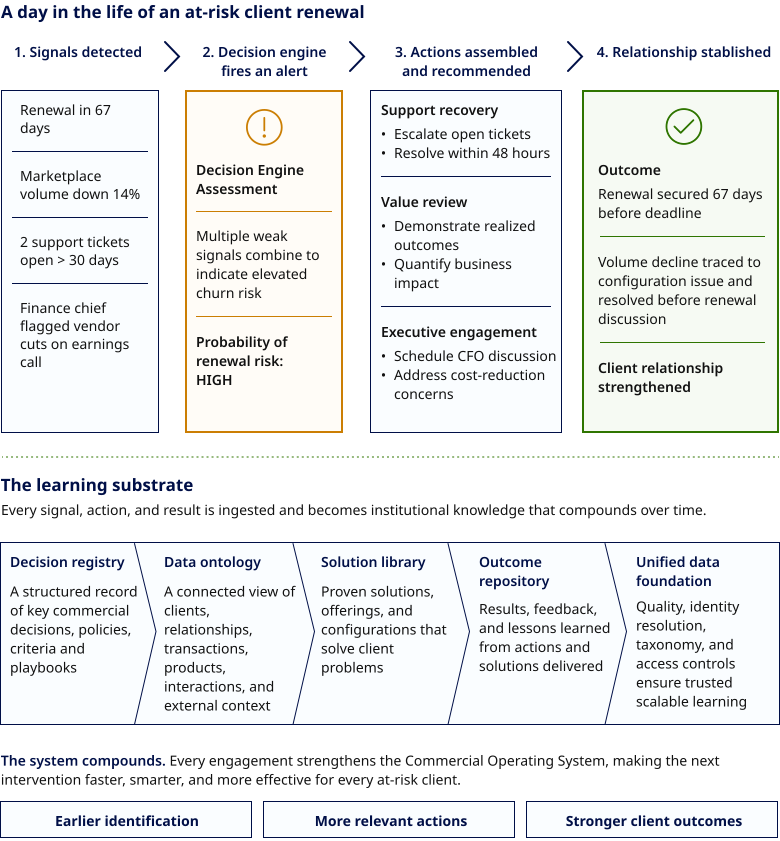
AI makes something more ambitious possible: a Commercial Operating System (OS) that can scale the pivot to solutions and make it sustainable. The Commercial OS is not a CRM enhancement or a workflow tool, but systems that record what has happened already. The Commercial OS determines what should happen next, and increasingly acts on that determination without waiting to be asked.
The Commercial OS is built on four interlocking components:
- A decision registry maps the decisions that the enterprise makes across the commercial lifecycle from engagement trigger to solution assembly to renewal. This is the foundation on which everything else is built.
- A data ontology is the integration layer that connects internal and external context across domains. It creates a single authoritative record per client — drawing on relationship history, need patterns, capability inventory, prior solution configurations, and operational data — and makes that record queryable by every decision in the registry. This is what replaces the personal network as the source of intelligence.
- A decision engine runs decisions continuously against the canonical model. Engagement triggers fire before a client has to ask. Capability matching surfaces the right solution configuration. RFP responses that previously took weeks of internal coordination assemble in days from pre-approved building blocks. Human judgment is reserved for the decisions that genuinely warrant it.
- An action surface is the role-specific interface that each client-facing professional sees: a prioritized view of what the OS has already resolved, and what requires their attention today. Colleagues at every level of seniority operate with the firm’s full commercial intelligence at their fingertips.
What makes the OS genuinely powerful is what happens over time. Every client conversation, solution configuration, win, and loss feeds back into the system. Need patterns sharpen. The capability registry updates. Solution templates improve with every iteration. Over time, consultative selling becomes an institutional capability rather than a function of who happens to be in the room. That’s the difference between a commercial model that plateaus when talent turns over and one that gets sharper with every deal.
Why the Commercial OS is a solution provider’s moat
The shift from product seller to solution provider is not a new aspiration. What is new is the combination of urgency and possibility, along with the tools to respond at scale. But the transition demands more than architecture. It demands a deliberate shift in what the firm asks of its people: less time assembling context, more time exercising judgment.
The most valuable account manager in the world that the OS creates may no longer be the one who knows the most, but the one who builds the deepest trust and makes the calls the system cannot.
The gap between an early mover and a late one will grow as compounded intelligence creates a structural information advantage that is very hard to replicate. The Commercial OS is a moat, but only for firms that build the organization to match.