


How does a company win in the race to incorporate AI into consumers’ financial lives? For the past several years, this question has percolated in all types of companies that serve humans — whether as end consumers, decision makers in business, or employees. While the precise strategy for meeting consumer needs will vary, it has become clear that consumers are searching for a path to use AI but just need a viable way for it to help.
Consumer attitudes toward AI in financial decisions
We recently surveyed 1,000 US consumers about their financial lives and conducted in-depth interviews with six AI users. Several findings stood out to us as especially salient or surprising:
- While consumers are broadly willing to use AI for financial needs, they are reluctant to use AI in the areas where they need the most help
- Current usage of AI unlocks little value, mostly replacing activity on search engines
- About half of respondents are excited about the prospect of using AI more, but a similar number are scared about this future state
- For both groups — the excited and the scared — regulation, education, and output validation are essential to building trust
- Banks are the most trusted provider category, outpacing tech and AI companies, when it comes to data protection
While these findings point to the promise of AI in financial services, most consumers aren’t yet using the technology to address their most pressing problems. On average across all needs, just 21% turn to AI for assistance, lagging financial providers’ non-AI resources like advisers and information (52%), family and friends (31%), and online research (29%).
Why consumers aren’t using AI for their hardest financial problems
To understand the dynamics of consumers’ willingness to use AI, we dove deeper into our survey respondents’ goals and perceptions. We mapped their willingness to use AI for each goal against their level of confidence that they will achieve the goal.
From this analysis we found that consumers aren’t yet willing to use AI for help with their thorniest problems. Instead, the financial matters with which consumers are most likely to trust AI center around one-time events, less important questions, and problems they already have a high confidence that they can solve.
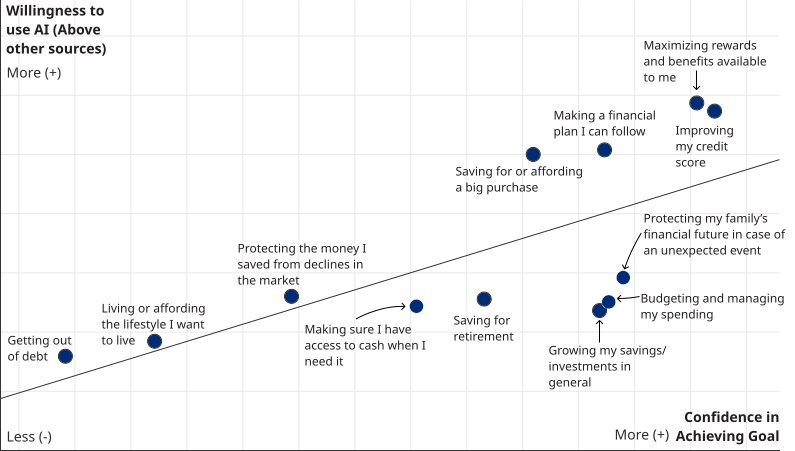
It might be tempting to conclude from this data that there’s no demand for AI to help consumers with their biggest problems, but consumer use of AI for simpler tasks suggests they want a better way to address their other needs.
What companies must do to unlock meaningful AI adoption
To fulfill these hopes, companies must address three considerations that we identified in our research:
Link AI tools to clear use cases
The consumers we surveyed were experimenting with AI to solve day-to-day problems: 78% of them used it to seek out information, and 48% looked to it for practical guidance. A good portion had used the technology for discrete financial tasks, with 26% seeking advice on choosing the best financial accounts and 23% looking for guidance on investments or budget building.
But in each of these cases, the mode of advice is largely analogous to a web search. The most common response to “What has AI taken the place of?” in our survey was “Quick research through Google or other search engines.” Unsurprisingly, just as searching the web hadn’t entirely helped customers to solve their deepest problems, this ad hoc experimentation with AI isn’t doing so either. It is mostly helping them do the same thing they did before, but faster.
Providing clear suggestions for substantial use cases is one short-term way to nudge more impactful experiences and unlock greater usage. In the longer term, focused innovation aimed at helping consumers beyond search-like queries will likely also reap rewards. Such innovations could include interfaces that ask people about their finances and provide suggestions for change, agents that assess their financial history and provide bespoke product recommendations based on what they’ve used in the past, or tools that look at patterns in consumer behavior and recommend small changes that could result in larger savings or better habits over time.
To persuade people to use such innovations, however, companies will likely have to address the two other considerations we identified.
Establish trust in AI outputs by showing your work
A further obstacle for companies is that for the moment, the AI tools that consumers know are famously unreliable: They return inconsistent results and hallucinate, thus requiring verification of outputs if a user isn’t an expert. In our research, nearly equal numbers of people said that they were excited (42%) and scared (43%) about the prospect of AI, and even among the optimists 87% said that some AI outputs shouldn’t be trusted without verification.
In our qualitative interviews respondents explained that they worked around this apprehension by using AI to quickly search for or generate things that they could verify or sense check for themselves — study plans, 3D models, Bible verses, wardrobe curation.
In some ways, this is an encouraging sign that consumers are confident enough in the promise of AI to find workarounds to combat the tools’ weaknesses. But for companies trying to win consumers by addressing their needs, it is also a warning: Until AI tools obviate the need for personal verification, financial goals that consumers don’t already know how to achieve will likely continue to remain out of reach of AI help.
One method to earn trust is to show your process. Outputs with links to sources, overviews of considerations, and detailed research approaches are more likely to be trusted than those that jump straight to an answer or recommendation.
Assuage data security concerns by showing personalized value
Our qualitative respondents were relatively sanguine about sharing their personal data with both financial institutions and AI tools, as long as their disclosures yielded tangible results. Half of our survey respondents indicated that they trusted financial firms with their data above other types of institutions — a far greater proportion than for AI and tech companies — because those firms already had long held their information safely.
That said, many consumers have their financial information spread across multiple institutions, so a source that can aggregate all pertinent data effectively will be able to offer greater personalization.
Eventually some subset of businesses will be able to create a virtuous circle of trust and data sharing; by being useful to consumers, these companies will inspire them to contribute more data and then will provide even more personalized results. This is a place in which AI companies may well catch up with financial institutions in terms of the balance of trust and utility.
Currently, savvy consumers who use AI tools for financial advice share information that is specific enough to their circumstances that they feel they are getting personalized results, but they are cautious to not step over the line of sharing the kind of personally identifiable information that financial institutions have about them.
But if AI and tech companies can provide more personalized results across institutions, the benefit may well seem worth it. Banks and other established players should be careful resting on existing trust perceptions, as AI platforms will likely earn more trust as consumers interact with them on a more consistent basis.
Turning AI curiosity into consumer loyalty
How, then, does a business break through the search-substitute mode of interacting with AI to create a solution that consumers will return to again and again? One enticing potential conclusion from our study is that the consumer stickiness hasn’t happened yet simply because the true innovation hasn’t happened yet. Consumer experimentation is a signal of hunger for solutions, but individual consumers are only able to work within the bounds of what they know, both in terms of the tools that are available and the answers that they can check for themselves.
A winning solution will be one that gives consumers the ability to solve long-standing needs, a reason to trust in the process because they can see the results for themselves, and the assurance that their personal data is being used responsibly. It’s a challenge to businesses: Consumers are eager for something to address their needs, and they think the answer might be AI. Now you just need to figure out how to help them.