


The confluence of energy, geopolitics, and AI is driving a commodity trading market reset: rewriting flows, compressing decision cycles, and raising the premium on resilience. The next generation in trading is taking on challenges that can’t be found in the history books.
To move on and engage capital markets effectively, the next generation of commodity trading leaders needs to set a clear vision to guide portfolio shape and origination, show rigor in cost efficiency, be bold in evolving the platform to embrace technology, and speak capital markets fluently to secure and retain funding.
The commodity trading market is resetting, not retreating
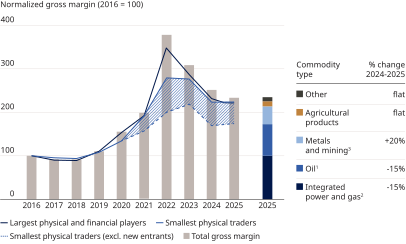
The total trading value pool has continued to contract, to approximately $92 billion in 2025, down 10% from 2024 and 40% from 2022’s high point. The total value pool remains at healthy levels of about double the 2016–2019 average. A strong second half of the year balanced a challenging first half dominated by event-driven swings across commodities. A select bright spot was metals, which posted 35% growth — well above its longer-term historic CAGR (2016–2024) of around 10%. Metals benefited from demand tied to the energy transition and defense industry growth.
For select market participants, 2025 may have felt like a low point only because it followed a run of record years. The 2025 winners are good at managing correlation, substitution, and rotation, and they have the scale to deploy capital and risk where the market is clearing. This market environment brings back the need for portfolio shapers and originators to drive market expansion and balance portfolios.
Challengers continued to gain market share in pockets such as short-term power trading, emerging markets, and metals, all three of which outperformed established players. Our analysis shows smaller physical traders trail leading trading houses by more than 20% when excluding new entrants since 2020. This shows that scale advantage plays an important role, but it can be balanced with a high-performing operating and technology platform.
The recent Middle East conflict has been a testament to the capabilities required to succeed in 2025, with commodity traders navigating market repricing on the edge of the next energy crisis. We have seen renewed uncertainty around energy flows, shipping routes, and risk sentiment translating into erratic volatility that at times presents difficulties to trade across commodities.
In this environment, a clear vision and a steady course for portfolio architecture matters. The ability to originate resilient flows, shape optionality, and continuously rebalance exposures is what creates the conditions for durable performance.
Seat economics are tightening as productivity declines
A key challenge to overcome lies in seat productivity. Topline decline is uncovering the growth in the number of trader seats and the increase in the cost of each trader seat, both of which accelerated significantly on the back of record profits post-2022, salary inflation, and ever rising IT platform requirements. This ultimately limits margin headroom, making productivity gains strategic.
We have now seen 2025 seat contribution margin fall below 2021 levels (by around 15% to 20%). This creates the perception of weak performance in 2025, despite topline results remaining elevated relative to the pre-boom years.
Countering the trend on economics requires simplification in the form of streamlining, fundamental restructuring, and portfolio reconfiguration. Cost reduction in trading is rarely straightforward: Done bluntly, it damages edge; done slowly, it fails to reset seat economics.
The tools to drive economics, however, are improving. Software vendors are expanding offerings around productivity tooling, workflow automation, and controls. AI is catching up to applications in the front office. The differentiator is not technology availability but, rather, rigor in action: clarity on where to standardize, where to automate, what to centralize, and where to protect true differentiation.
This is the moment to complement profit and loss-led and risk-led steering with income-led steering in performance management, to incentivize cost efficiency in an otherwise topline-driven business. Leaders who pull this through decisively will stay on top of economics.
Trading is shifting toward asset intensity and capital discipline
With rent migrating toward diversified portfolios — as illustrated by the more than 20% gap between smaller physical and leading trading platforms — the way trading value is captured is changing. We see the shift impacting a core paradigm: from “securing length to trade down” as a typical entry point toward “owning the ecosystem” to trade around.
This goes beyond individual assets, customer books, or trade flows. It reflects two important topline trends: a growing focus on origination to bring additional business onto trading platforms, and rising asset intensity as trading models increasingly index on rateable cash flow. More broadly, value creation is concentrating around choke points, portfolio correlations, and the ability to price trading value into origination, transactions, and investments — ultimately driving up the asset intensity of trading businesses and reinforcing the link to customer needs.
Higher asset intensity requires funding and a more capital-market-oriented narrative around the equity and debt story of the business to secure it. Management needs to be literate in the key elements of the capital markets narrative and communicate them consistently and concisely. Lenders and equity holders will increasingly ask a different set of questions: Where is cash flow rateability coming from? How are debt servicing and dividend requirements protected across cycles? What governance exists to prevent balance sheet expansion from outpacing risk-taking capability and physical and financial exposures from getting out of sync?
Answering those questions requires thorough risk management and governance, and a clear link between enterprise value and steering and performance management. It goes beyond the role and responsibilities of a trading CFO as the custodian of the balance sheet, and needs to be embraced by all members of the executive committee. Their new goal: ensuring there is a demonstrable business course in line with capital market requirements.
In practice, the winning posture for establishing a capital markets link to steering is “think like a banker, act like a trader.” As a leader in trading, use the banker case to set boundaries and trigger thresholds in steering; retain the trading DNA as the source of value uplift, to capture asymmetric upside and the license to operate. Demonstrating the resulting cash flow rateability allows for raising long-term debt and accessing more patient capital when needed, for example for more mergers and acquisitions to accelerate the next phase of growth, or for balance sheet restructuring.
A generational shift is reshaping trading talent and operating models
As a generational handover continues across top jobs in the industry, the population of leaders is getting younger and more tech savvy. Yet the people challenge remains, and it is not a generic “war for talent.” It is a capability debt problem created by two decades of uneven cycles:
- Experienced top traders have retired, taking knowledge of trading across cycles with them
- The middle layer is thin, as trading markets were starved in the 2010s
- Young professionals have largely only seen record years and need training across multiple disciplines, risk instincts, and tech integration
The pressure on the talent base extends well beyond the front office. Middle and back-office functions, including risk and finance, face parallel capability gaps as their roles increasingly shape decision-making in complex technology and data environments. Retaining talent and ensuring sufficient experience (including bringing back retired experts) remains a key challenge across all functions.
This is a chance to fundamentally restructure operating, steering, and organizational models to be more tech native.
New operating models have been born and tested around hedge fund approaches, and data-intensive short-term trading is ready to be adapted. For example, the third generation of tech-native traders is operating at 25% of the seat cost of traditional setups.
At the same time, the traditional energy trading and risk management (ETRM) model, a single application that captures all data and manages processes sequentially across the trade lifecycle, is giving way to more data-centric architectures. Organizations are investing in analytics platforms that aggregate data from multiple systems, elevating the importance of data quality and governance. Alongside the proliferation of specialized, process-specific applications and the rise of AI, these developments are pushing traders in increasingly complex technology architectures toward a more data‑centric approach.
AI is a catalyst, particularly useful in cleaning and connecting the wealth in unstructured data sets. On top of this data, the industry is moving beyond buzzwords and expensive, reactive piloting in this space. Measurable impact on productivity and cost base (beyond 20%) can only be achieved by moving away from single bolt-on use cases and toward a more fundamental rethinking of how to embrace AI in the trading organizational and operating model. Success will lead to genuine change in workflows, decision support, and controls.
The leaders who emerge strongest from this transition will strike a deliberate balance: bold restructuring and operating model reset, while protecting the roles that create the competitive edge and retaining top talent. In a reset market, people are the integration layer between tech capability, market opportunity, and disciplined risk taking.
Four imperatives to move on without losing the trading DNA
Amid the market reset, productivity squeeze, generational handover, and rising asset intensity, leaders need a simple compass to guide decisions under pressure.
Set a clear vision for where the portfolio is going
What good looks like: a crisp view of where to originate, where to deploy the balance sheet, and which risks are noncore. It also means having a clear diversification logic — not simply more commodities or broader expansion, but deliberate choices around correlation, optionality, and portfolio shape. The growth plan should be anchored in origination and portfolio shaping that can endure beyond a single cycle.
Early moves: re-segment the portfolio into a tradable core and a more opportunistic set of edge positions. Reset capital allocation rules to reflect the repriced market rather than the assumptions of the boom years.
Show rigor on cost, capital, and accountability
What good looks like: steering that treats trading as a cost-, capital-, and risk-constrained business. That includes desk-level break-even transparency with fully loaded costs, as well as clear accountability for platform costs and workflow standardization.
Early moves: shift performance management from a pure profit and loss lens to one that also reflects cost and income. Identify the roles that truly create edge, protect them, and industrialize the rest.
Be bold in evolving the operating model
What good looks like: an operating model that matches today’s talent and technology reality. AI should improve workflows, decision support, and controls, not sit off to the side as a pilot. The talent model should also train for cycles, disciplines, and integration across trading, risk, finance, and technology.
Early moves: replace broad AI experimentation with targeted front-office use cases tied to seat economics, and deploy off-the-shelf tools where they can create measurable productivity gains. Build a deliberate cycle literacy program for younger talent and reinforce it with senior advisory capacity where needed.
Speak capital markets fluently
What good looks like: a funding narrative that explains rising asset intensity and defends cash flow rateability across cycles. It also requires governance and risk triggers that are credible to lenders and boards, and a clear link between enterprise value and steering across risk, capital, cost, and performance.
Early moves: define and publish internal balance sheet and risk thresholds, and enforce them. Translate trading strategy into lender language — including coverage, liquidity, and downside resilience — so the business can secure funding without losing its trading DNA.
The opportunity and prospect in trading remains substantial. The edge is moving toward portfolio architecture, disciplined productivity, modern operating models, and a credible capital markets story. For the next generation of trading leaders, “moving on” is not about doing more. It is about doing the right things before the market makes discipline optional again.
