


The economic and political consensus of the last few decades has rapidly and dramatically fractured, shifting away from the globalization of capital, international economic cooperation, and trade liberalization towards resource nationalism and trade barriers. While signs of this fragmentation began to crop up several years ago, 2025 has seen a dramatic uptick. Trade and investment policies, especially those out of the new administration in the United States, have pushed the world toward a new economic reality.
The current status quo is about hard power and direct control over resources taking primacy over trade cooperation, liquid and transparent global markets, and anonymous financial exchange.
The evolution of modern commodity trading
Modern commodity trading as we know it emerged in the 1970s in a similar environment, catalyzed by nationalistic resource independence efforts. This allowed a new breed of specialized intermediaries to address informational asymmetries, cut deals with distant parties, and profit from wide arbitrages. In the intervening years, global commodity markets, and with them the commodity trading industry, have become more mature and increasingly abstract, with a strong focus on maximizing efficiency in liquid global markets. As the industry has come of age, traders have increasingly taken on a more public-facing role and become even more critical to the functioning of global supply chains.
Traders have increasingly succeeded on the strength of their analytics capabilities, from proprietary intelligence and algorithmic trading to significant investments in predicting the weather. The modern commodity trader makes thin unit margins on enormous volumes; their increasing participation across global markets has helped to widen and deepen previously illiquid markets like battery metals and liquefied natural gas over the years.
Rising geopolitical volatility reshapes commodity trading
Today’s new kind of instability challenges the precepts underpinning the modern commodity trading industry. While traders were hugely successful in the market resettling after Russia’s invasion of Ukraine in 2022, today’s broader and less predictable shifts are more challenging.
All trade is likely to be less straightforward. Even before considering the impacts of economic changes, traders are reckoning with the impacts of unpredictability itself. This is likely to be a hallmark of the foreseeable environment, with sharp market movements driven by an increasing global willingness of some players to use aggressive tactics in both trade and military disagreements to elicit concessions. Tariff-related announcements have created difficult-to-anticipate volatility in commodity markets many times over as tariffs are raised and lowered without notice.
Trading around this short-term, event-driven volatility is challenging, though windfall profits have accrued to some with the stomach to bear equally sudden losses on occasion. While immediate market reactions to these events are often severe and potentially punishing, the fundamental market shifts behind the announcements have been frequently less dramatic. Building a trading position that is robust enough to withstand the short-term fluctuations and accurately identifies the true direction and intensity of market movements amid changing policies has proven to be a challenge.
Exhibit 1 shows that while price volatility has been similar in 2024 and 2025, the unpredictability of price movements has been higher across a basket of commodities, indicating a shift that has made trading more challenging for many market participants.
Energy and mineral security is now the top geopolitical priority
Global geopolitical compacts are experiencing a fundamental restructuring. A system premised on close and comprehensive US support of allied economies in Europe and East Asia has been met with deepening nationalism and discussion around a more isolationist foreign policy. With American allies left in a position where they may not be able to rely on unquestioning US support, we have seen structural shifts in policy towards self-sufficiency.
Governments are responding through regulation and direct investment into production. Both represent a shift from recent practice for Western countries in particular.
This impulse to security has been building over time, accelerated by general geopolitical shifts and specific shocks to market participants, including major deals being reneged upon with dramatic consequences. Prime examples are the sudden cessation of Russian gas supplies to Central Europe and the refusal of private LNG players to fulfill contracts.
When purchasing LNG, some governments have found their counterparties unreliable and willing to take the reputational hit for not delivering contracted supply so they could make more in the open market. Major international mining companies are finding their investments undermined by sudden impositions of export bans that block the overseas sale of their ore.
Regulatory pushes promoting self-sufficiency include national critical minerals strategies, many of which require increased local production and refining of critical minerals, and energy security mandates, including Europe’s requirement for countries to fill up their gas storage facilities.
The rush to guarantee adequate supplies of critical resources is also behind direct investments by the US Department of Defense in a rare earth mineral mine and Australia’s stake in major rare earth refineries. More creative arrangements are trading off geopolitical priorities and resource control explicitly — whether it is the minerals deal between the US and Ukraine linking physical and resource security, or the recent deal between Saudi Arabia and Airbus to swap titanium offtake for airplane deliveries.
This emphasis on physical control over supply is also evident in the rebalancing of priorities around sustainability versus energy security. Countries and companies — even those once at the forefront of the energy transition — are increasingly focusing on ensuring energy security; exemplified perhaps by Canada’s likely support for new oil infrastructure.
Commodity traders will succeed by re-focusing on origination
Traded markets are increasingly diverging. Some highly liquid markets will continue to see the dominance of digital platforms and balance-sheet backed activities. Many other markets, however, are seeing the re-emergence of more bespoke and higher-margin origination and structured trading. Greater unpredictability and geopolitical shifts have moved these commodities down the liquidity curve, providing wider spreads for traders to profit from. Margins on single transactions could be much higher than in recent years — but they will be volatile and challenging to control, requiring a different kind of positioning.
Exhibit 2 illustrates the direction of travel for some commodities between 2024 and 2025; several key commodities are moving towards higher margin potential, especially for independent traders comfortable trading in less liquid environments.
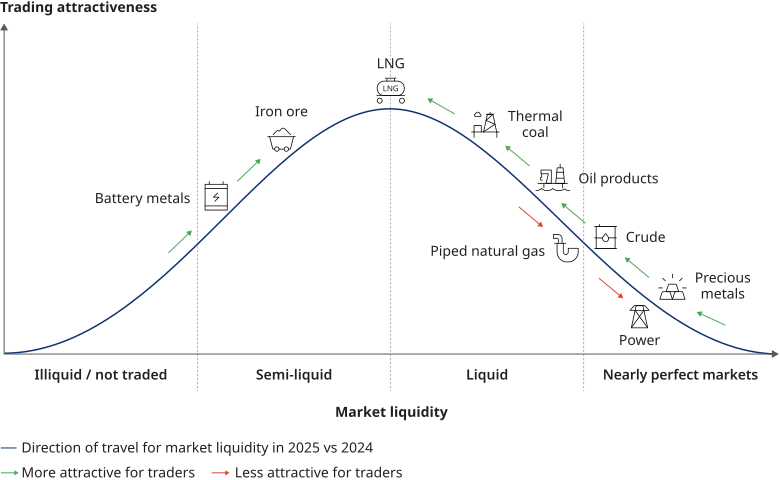
To succeed, traders will need to build their origination efforts, responding to calls for resilience, working more closely within regional blocs, and ensuring additional expenditure is deployed smartly.
Regional resilience efforts are creating new opportunities for traders
The emergence of regional blocs creates both short-term and long-term opportunities for traders who emphasize origination. In the short run, greater emphasis on security of supply creates premiums for those able to deliver near-shored supply.
This was first visible in European gas markets, with a flurry of long-term gas supply deals after Russia’s invasion of Ukraine and, more recently, has characterized some metals markets, especially those for rare earth metals.
Over time, as markets adjust, these ‘security of supply premia’ will decline. Instead, the longer-term opportunity comes from regulation and infrastructure investment in regional risk buffers. In European gas, these include support for LNG terminals, requirements to fill gas storage facilities, and the creation of national energy import champions.
Recently announced critical minerals investment funds create the possibility for traders to take on active roles, helping governments secure supplies. While these risk buffers are intended to decrease the magnitude and frequency of price movements, they will still create opportunities for traders if they can take on attractive asset positions and respond to new regulation-driven price dislocations.
Building trust within trading and regional blocs is now essential for success
In today’s environment, reliability and trustworthiness are more important than ever. Partnering with governments to help them meet core regional priorities will help improve prospects. Active engagement with regional blocs on key priorities will help open up opportunities, including those driven by government pushes for resilience.
When it comes to investments, traders may want to consider the strategic value of supporting governments on their priorities alongside financial returns. Those that already have strong links to blocs should focus on how they can use relationships and reputational guarantees to their advantage.
Rising capital costs reshape origination strategies for commodity traders
Greater emphasis on origination and business development is expensive, especially as interest rates remain elevated. Given the kinds of risks present in today’s market, we expect costs of capital to remain higher than in the past decade.
More working capital will be needed to maintain short-term inventories and acquire transport and storage assets. More risk capital will also be necessary to buy shares in new sources of supply. Access to cheap funding will become a differentiator for many traders, and some traders will opt to invest cash accumulated during previous boom years and to present themselves as more rateable, financeable platforms.
This environment also makes long-term contract risk management more important than ever to balance short-term value extraction with consistent valuation and hedging of long-term exposure.
The history of commodity trading indicates that changes to the global political and economic order can often benefit intermediaries, opening up new opportunities to drive commerce through uncertain times. While the consensus of the past few decades is unravelling, traders should reach back into the past for lessons on how to adapt and position themselves for a new era.
