


European companies have weathered an extraordinary series of shocks in recent years. The COVID-19 pandemic disrupted demand and supply chains, while the war in Ukraine contributed to sharp increases in energy, raw material, and transportation costs. Even with that pressure, many businesses held up well.
But being resilient now does not guarantee resilience in the future. Companies face a mix of challenges, from higher debt and tougher financing conditions to geopolitical uncertainty and shifts in technology and customer behavior. For companies under pressure, the ability to develop and execute a convincing transformation and restructuring strategy is becoming increasingly important.
Despite severe disruption, the financial performance of European companies remained strong through successive crises.
Financing also played a key role in helping companies weather these challenges. Government support and lenders helped businesses cover funding gaps, with loans to eurozone companies rising 16% from early 2020 to the end of 2022.
The delayed effects of recent crises could pressure liquidity
Some of the pressures companies faced in recent years are starting to ease. Commodity prices are falling, and supply chains are moving closer to normal. However, some companies are now feeling the financial impact. Businesses with long order cycles may be completing contracts agreed when raw material costs were much higher. If they could not pass those extra costs on to customers, their profits and cash flow may come under pressure.
Companies need to manage both their current performance and the financial impact of challenges and decisions from the past. Financing conditions are becoming more demanding, particularly for businesses already under financial pressure.
In our 2023 Restructuring Survey, 69% of surveyed lenders said they had increased their requirements when considering providing capital to companies with weak financials.
Survey participants placed particular importance on a company's financial plan, market environment and competitive position, management capabilities, current financial data, and strategy and business design.
Therefore, a strong restructuring plan needs to go beyond short-term cost cutting. It should demonstrate how the company will address its competitive environment, improve performance, manage liquidity, and build a sustainable business model, as well as how management will execute the necessary changes.
Disruptive trends and geopolitical risks require a strategic response
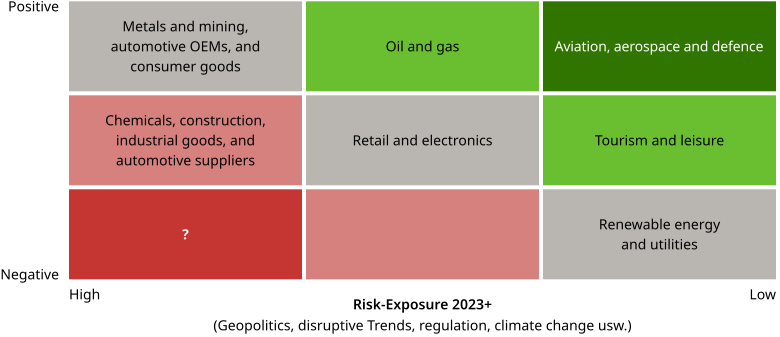
During the pandemic and the early stages of the war in Ukraine, energy costs, raw material prices, and supply chain disruption dominated management agendas. However, looking ahead, survey participants identified changes in technology or customer buying behavior and geopolitical developments as two of the most important potential drivers of future distress.
Trade conflicts, climate-related requirements, digitalization, and changing financing conditions add further complexity The impact will be different across industries. While some sectors have recovered well, others are still dealing with the effects of recent crises and new market changes. Companies facing both may experience increasing pressure and risk.
How European companies can restructure for resilience
Government support played a significant role in helping companies navigate recent crises, but businesses should not assume the same level or form of intervention in the future.
Almost 60% of survey participants said governments and central banks should continue to help European businesses address future challenges. Although respondents placed greater emphasis on measures such as accelerating innovation, creating demand, and improving legal frameworks for restructuring than on direct financial support.
At the same time, 42% said no more government support should be provided and that the market should be allowed to adjust on its own. For executives, the implication is clear: Companies need to develop their own response.
A sustainable restructuring strategy should address the market and competitive environment, establish a realistic financial plan, strengthen operational performance, and demonstrate management's ability to deliver change. Altogether, these elements can help build confidence among lenders, shareholders, and other stakeholders.
European companies have already demonstrated their capacity to navigate difficult conditions. The next challenge is to turn that resilience into lasting transformation. As financing becomes more selective and disruption accelerates, companies with convincing strategies and executable plans will be better positioned to secure stakeholder support and emerge stronger.
