


With economic growth subdued, commodity costs rising, and bank lending tightening, European corporates face challenging business conditions. This is particularly true for companies in distress and those seeking capital for any kind of restructuring. Given the growing shortfall in corporate financing, private debt is emerging as a relevant complement to traditional bank financing for companies needing capital for turnarounds, refinancing, or liquidity support. Our 2026 Restructuring Report explores ways private debt can be used to fill the gap, drawing on insights from a survey of more than 100 restructuring experts across Europe and supported by Oliver Wyman analysis.
European corporates need funding for growth and recovery
The financing challenge for companies is being shaped by several forces at once, including sluggish growth across the European Union, elevated energy costs, and geopolitical uncertainty that are curbing both confidence and investment. Survey respondents report that significant numbers of corporates are facing flat or declining revenue, margin compression, or earnings stress. Insolvency levels have also increased significantly compared with 2021, indicating that many businesses are not simply underperforming but may need to restructure.
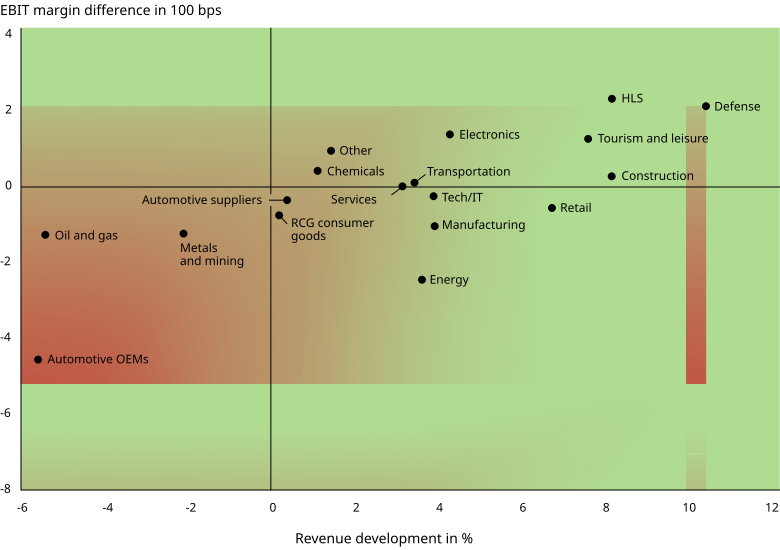
The financing needs of these companies are also changing. In the survey, capacity expansion and footprint reorganization rank highest, followed by turnaround and restructuring measures, loss compensation, and refinancing needs. That pattern suggests a market where capital is needed not only for growth, but increasingly for stabilization and recovery.
Banks are reducing risk appetite as demand for capital rises
Bank debt has historically been the cornerstone of European corporate financing, particularly in mid-market and sponsor-backed structures. But more than 60% of surveyed financiers expect to reduce their risk appetite over the next three years, and a substantial share also expect to reduce financing volumes.
As banks become more cautious, the gap between capital demand and capital availability widens. For companies in restructuring situations, this can make the difference between a credible implementation path and a delayed or incomplete process.
Private debt becomes a key source of restructuring capital
The survey results indicate broad recognition of private debt as a viable financing option in restructuring situations, with more than 80% of respondents considering it an attractive alternative, primarily in situations when bank debt is unavailable. Private debt funds have expanded rapidly in Europe in recent years, and that growth has allowed them to be more active in current restructurings. Even so, the asset class still represents a relatively small share of total European corporate credit — not yet large enough to absorb the full financing need created by increasingly risk-averse banks and higher restructuring demand.
Restructuring success depends on bank and private debt alignment
The best use of private debt is often alongside bank debt, not in place of it: When banks and private debt funds work together, respondents see several clear benefits. These include shared risk and upside, faster execution of the restructuring process, and improved funding reliability in situations where one financing source alone would not be sufficient.
At the same time, collaboration is not straightforward. Multi-creditor structures can create tension around pricing, governance, security packages, and execution speed. The biggest risk arises when creditors no longer share a common endgame for the restructuring. That is why alignment of objectives is so important. Without it, even well-structured financing can create friction rather than value.
Restructuring success starts with a credible turnaround plan
One message comes through very clearly across the research: financing alone does not create a successful restructuring. Whether the capital comes from a bank, a private debt fund, or a combination of both, lenders will only commit if the borrower presents a credible restructuring concept, supported by robust financial planning and capable management. Professional liquidity management is equally essential. That means the quality of the restructuring work itself remains the foundation. Capital follows conviction.
