The financial services industry has become more stable and resilient over the past decade. Beneath that relative stability, however, a significant shift is taking place in where the industry creates value.
Data and technology are driving faster growth in capital-light services and changing the position of traditional banks, insurers, and asset managers. Incumbents accounted for about 90% of industry value 10 years ago. Today, their share is about 65%, with big tech, merchants, and financial infrastructure and technology (FIT) firms accounting for the remaining 35%.
The result is a new, wider financial services industry, with the value and nature of financial services continuing to expand.
Data and technology are capturing more financial services value
Over the past decade, traditional risk intermediation has grown more slowly than newer financial services built around technology and data.
Risk intermediation services have grown globally at about 3% a year over the past decade. By comparison, connected data and value technology services have grown at about 10% annually.
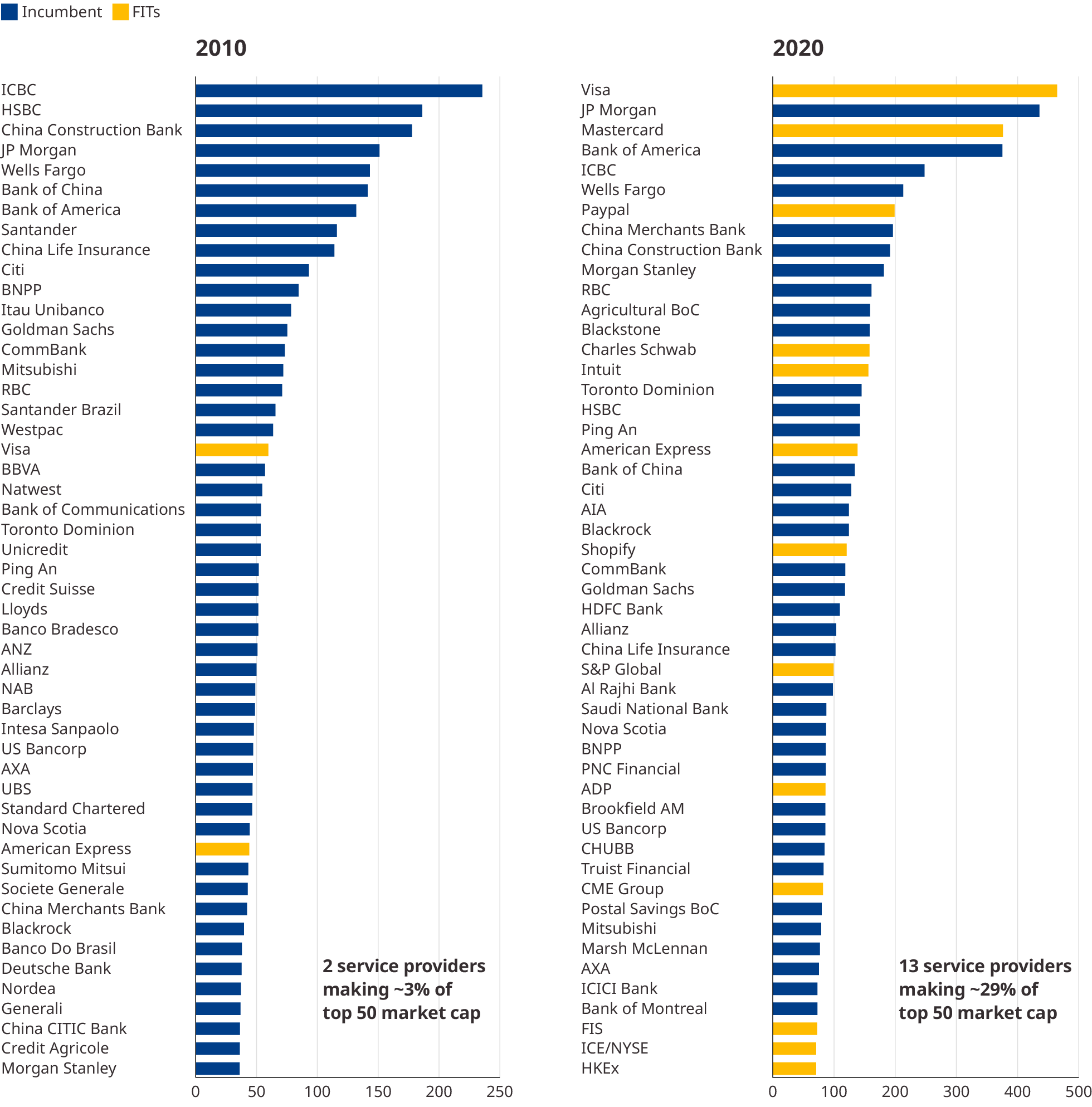
That difference is also visible among the industry's largest companies. A decade ago, only two of the top 50 financial services-focused firms were not incumbent banks, insurers, or asset managers. Today, close to one-third are FIT firms.
Traditional risk intermediation remains central to financial services, but the value of technology and data services is increasing.
New financial services are emerging around customer needs
Financial services are expanding as new data and technology combine with evolving customer needs and expectations.
The emerging industry can be divided into three broad service segments: risk intermediation, value technology, and connected data services.
Risk intermediation services: These involve matching those who have money with those who need it, while the provider takes some financial risk along the way.
Value technology services: These use technology to deliver a new service to an end customer, rather than simply improving an operation or function.
Connected data services: These rely on using data or connecting different sources of data to create value for customers, such as helping them manage their financial health or making it easier to manage logistics, real estate, mobility, and health.

The expansion in the nature of financial services is based on new data and technology and evolving customer needs and expectations. Faster growth in new capital-light businesses is also creating greater potential for value creation, although which firms will ultimately deliver these services remains uncertain.
More players are competing for financial services growth
As the value of technology- and data-related services has increased, new competitors have emerged across financial services.
In 2010, the industry largely consisted of banks, insurers, and asset managers alongside technology and service suppliers. Today, the picture is considerably more complex.
Incumbents, big tech companies, merchants, FIT firms, and other new players increasingly operate across the same financial services value chains. Firms can sit in each other's value chains in simultaneous partnership and competition. The result is a very different financial services industry from the one that existed a decade ago.
Incumbents need to look beyond defensive digital transformation
Banks, insurers, and asset managers have spent much of the past decade digitally transforming their businesses.
They have improved digital customer experiences, digitized processes, launched new digital businesses, and developed partnerships that move them toward data and technology platforms.
Much of this work, however, has been defensive. Incumbents have largely protected their existing customer bases and risk intermediation franchises but have had less success in capturing new and growing sources of value.
Managing a mature, asset-intensive business while also pursuing high-growth, asset-light businesses is difficult. It can require a decisive shift in management and investment focus toward new sources of value, including different organizational structures, investment mechanisms, and capital structures.
The future financial services landscape remains uncertain
How the financial services landscape evolves over the next decade is far from certain, depending both on market conditions and on how policy and regulation evolve.
Four possible scenarios include:
Continued expansion with incumbents becoming utilities: More capital-light technology and data services are picked up by FITs, big tech, and merchants, with consolidation of the fintech industry into a smaller number of bigger winners and incumbent banks, insurers, and asset managers increasingly limited to providing risk intermediation services.
Market-driven rebalancing: A shift in market conditions, such as prolonged high interest rates combined with a severe correction in technology valuations, drives consolidation of incumbents with small- to medium-sized FITs firms and supports incumbents regaining ground in connected data and value technology services.
Policy-driven rebalancing: Policy and regulation put greater constraints on firms growing quickly in data and technology services, including digital assets, rebalancing the system back toward incumbents.
Trust-busting crisis: A significant crisis causes a dramatic loss of trust, with cyber or privacy breaches potentially creating the next major trust crisis as financial resilience improves and privacy concerns increase.