


The airline industry has come a long way in the 100 or so years since American aviator Charles Lindbergh made the first solo nonstop flight from New York and Paris in 1927, but it is now facing one of the most significant workforce challenges in its history.
Over the next 10 to 15 years, a wave of retirements will create a global pilot shortage as airlines grow faster than ever and technology fundamentally changes what it means to fly a commercial aircraft.
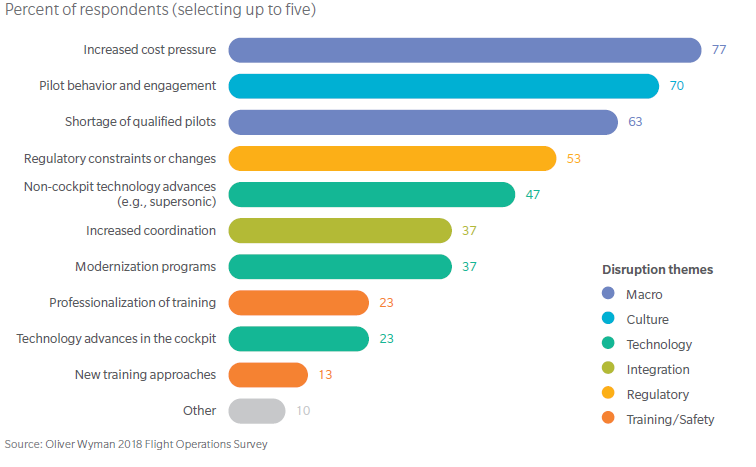
These are the central findings from our inaugural 2018 “Flight Operations Survey”, which draws on one-to-one interviews with executives and a survey of senior management at international airlines, cargo operators, original equipment manufacturers, and training companies. Across the board, one concern came up more than any other when we asked which disruptors would warrant the greatest challenge over the next five years: cost.
Close behind, cited by 70% of respondents, was pilot behavior and engagement, and 63% flagged the shortage of qualified pilots. What emerges is a picture of an industry that knows the challenge is coming but is still working out how to respond.
A global pilot shortage is arriving just as airlines are at their largest
In the US alone, more than 30% of pilots will reach mandatory retirement age by 2027, leaving a major gap just as the industry is growing. Boeing projects that North America will need 127,000 new commercial pilots over the next two decades, and Asia faces an even larger shortage, with 240,000 new pilots needed by 2037. The average global commercial airline has also grown its fleet by 45% since 2000, putting further pressure on flight operations departments to employ qualified pilots. Finding pilots will be one challenge and keeping them another.
The next generation of pilots will be harder to attract and retain
Future pilots will be in very high demand, with multiple job offers available even before flight school as airlines compete to lock in young talent. Once qualified, the competition for their services only intensifies. They will expect real-time visibility into their performance and schedules, seamless connectivity with colleagues, and transparency about anything that affects their working lives. As one flight operations leader said, money alone does not buy engagement. Pilots need to know their voices are heard and that those they work for have their back. Flight operations departments that fail to deliver on those expectations will struggle to maintain the reliable, fully staffed operation their passengers expect.
Cockpit technology is advancing faster than most airlines are prepared for
The aerospace industry is undergoing rapid technological change, and while most respondents don’t expect major advances to be ready for widespread adoption before 2030, the pressure is building. Fleet modernization, cockpit innovations and supersonic travel are all ready to board but regulatory adaptation is the biggest barrier, cited by 63% of respondents. Airline readiness, implementation costs, and cybersecurity follow in the list of worries.
The most promising near-term additions are technologies that are intuitive and platform-agnostic: multi-touchscreen capabilities that would bring the cockpit closer to today’s tablet interfaces, synthetic vision systems that give pilots a 3D model of their surrounding environment, and wearable avionics such as head-mounted displays already in use in military aviation. Longer term, single-pilot operations are being actively discussed, with cargo carriers and high-growth markets in Asia expected to move first. Airlines that fail to plan for that transition will fall behind.
Airlines that invest in their pilots now will set the standard for the industry
The response to all three challenges runs through flight operations. Building a stronger recruitment pipeline means reaching candidates earlier, through cadet academies and loan programs of the kind already launched by American Airlines and the Qantas Group, and actively recruiting from underrepresented groups such as women, who make up just 5.2% of pilots globally.
Training needs to be overhauled to reflect how the next generation learns, with greater use of virtual reality, mobile apps, and streaming video, and a stronger emphasis on soft skills. And engagement needs to go beyond pay and benefits to give pilots a real sense of connection. The flight operations departments that tackle these challenges now will be the ones flying out in front.
