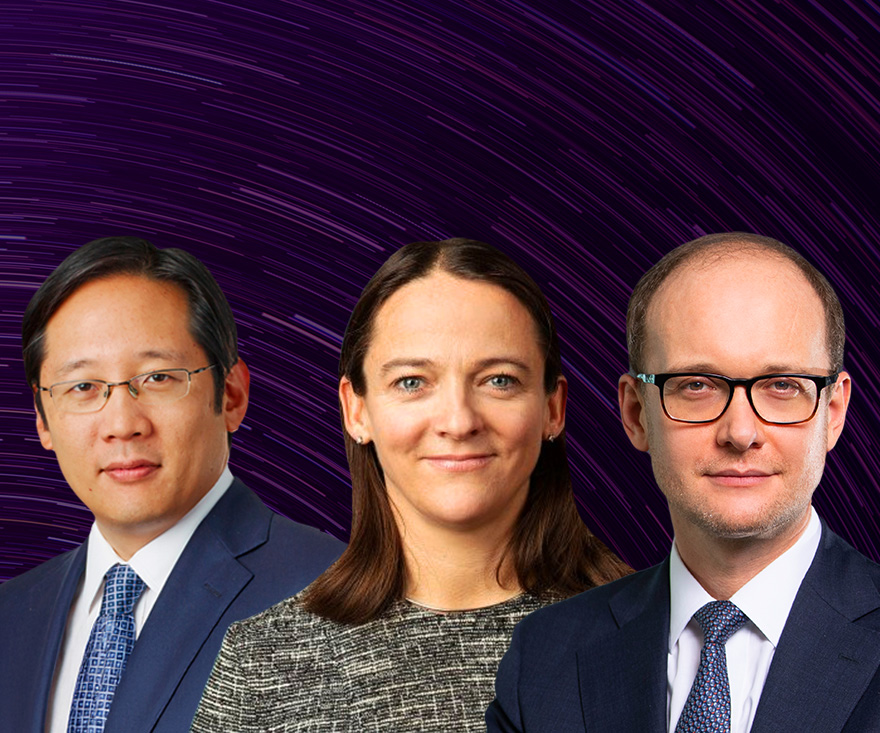
Intro: Hi, and welcome to this special episode of the Innovators Exchange, which was recorded live during the FIA conference in Boca Raton with a select group of our clients in the audience. We were delighted to welcome three guests to the conversation today. Michael Syn, president of the Singapore Exchange, Daniela Petterhoff, chief strategy and transformation officer at Nasdaq, and Anthony Attia, the global head of Derivatives and Post-Trade at Euronext. Through today's conversation, we will explore what it means to lead a financial market infrastructure group through now and into the 2030s, particularly poignant given the current geopolitical landscape. Thank you for listening.
Hiten Patel: Good morning, everybody. Thank you for joining us. Great to see so many familiar faces. Just want to set the scene for the conversation today, and I think those of you who are familiar with the Innovators Exchange, I know we've got some ex-guests of the show in the room, Christian, Brad, a few others. What we try and do here is have a bit more of an informal, relaxed conversation, a bit more personal, a bit more individual. We just want to take a step back, really, reflect on what we've heard, where we think things are at, and explore some of the key topics, front of mind. I'm delighted and very thankful that we have three kind volunteers and excellent speakers this morning. Michael Syn from Singapore, Daniela Peterhoff from Nasdaq, and Anthony Attia from Euronext.
We're just going to have a bit of a chat, really, and hopefully it'll stimulate your thinking and be a constructive addition to all of the touchpoints that you've had at the conference. Before I tee up my first guest, I just wanted to share some personal reflections to frame the questions that we're going to go through today. I think if I look back at my own interactions at Boca, if I look across the global coverage conversations we get to have in the seat at Oliver Wyman, we are in quite a unique position and situation at the moment. The level of geopolitical flux, the focus on things like the energy transition, climate transition, whole of Western Europe and a lot of the Western economy trying to find growth. There is quite a bit of broader soul-searching going on.
I think what I've noticed out of those conversations is you've suddenly got very localized and regionalized agendas. You know, five, six, seven, eight years ago, it was a very globalized agenda. I'd go to Saudi, I'd go to Hong Kong, you'd go to wherever. Everyone would want to know what's happening in other regions. Actually, now people are very focused on what's happening in their own backyard. The second thing I'd point to is I think there's now a greater tension in the trade-off between your role as a public company, if you're running one of these FMI [Financial Market Infrastructure] groups to maximize the shareholder return but also fulfilling some of your public policy duties. What do you need to serve your local economy? What do you need to serve your local agenda? And I think this has crystallized quite profoundly in the recent elements.
So, at the heart of all of this, when I take a step back, it feels like we're in a little bit of an existential moment for some of the largest financial infrastructure, financial technology, financial data groups. Who do we want to be and what's our role in all of this? So the exam question I'm going to wrestle with, the guys who've kindly volunteered, is a little bit around what's the role of FMIs through to 2030 and beyond, and intentionally picked a very out-there time frame, because one of the things that came up in my bilaterals this week was some people are really worried about two, three years ahead and trying to solve for that. Some others from other parts of the world were thinking in decades, and actually in some other parts of the world were thinking in centuries, which was kind of profound when you think what you're solving for. So, without further ado, I'm going to ask Michael to finish gobbling down his steak and eggs and drag him up here. So come on board, Michael. For those who don't know you in the room, Michael, do you want to do a brief intro?
Michael Syn: Hi, I've just come a long way from Singapore to see all of you. It's glorious to be here. I've not been to this event before. So, I am the president of Singapore Exchange, so I run the front office business units. We're still very much a traditional exchange, stock exchange, futures exchange, but we're trying to be like the big exchanges, you know, software businesses, indexation businesses, and that's proving quite hard yards.
Hiten: Awesome. Thanks for being here. So, I'm going to start you off with your reflections from your conversations at Boca. What's the new news that you've picked up on from your time here?
Michael: Okay, so coming from a distance, you need to understand the lens that we take. Very small country watching the big dogs doing what they do. So, the thing that's been quite surprising is how polite people have been, how sheepish they've been in addressing the whole issue of, you know, great power contestation and decoupling and all that. And I think some of that's just due to the fact that the market environment right now is quite good. And nobody really knows whether it's because of their efforts, despite them, regardless. So, there's a there's a huge amount of uncertainty around what you're supposed to do in the way of a business, especially what Boca represented historically, which is just building bridges between infrastructures.
So that part was surprising. And one reflection of that is every year, we try and rock up and make a couple of announcements just to remind people that Singapore exists, or Asia exists. And we've never had as much attention, like people are being excessively attentive. Like, oh, tell me more about the things you're doing in Singapore. And I'm sure it is sincere, but I think it's indicative of an attitude of mine that says we're uncertain about fragmentation and what this means to the fundamental rails of the industry that's evolved. So, we announced crypto in Brazil in real [official currency of Brazil] and in a normal year at Boca, nobody would really care. But this year, they're like, oh, tell me more about Singapore to Brazil.
Tell me more about how perps work out there. So, I think we're heading through a transitional period, and the headline noise will progress. What I haven't seen much of is the other Asian exchanges. That's quite notable. So, in the past 15 years since I've been here, you've always had more presence from China. We have the Indian exchanges here, but most of the other Asian exchanges have chosen not to come.
Hiten: Any views on what's driven participation choices from others from across the region?
Michael: Priorities. The fact that actually the largest areas of capital markets growth are now quite regionalized. And if you had to take a long-term growth plan, I mean, the U.S. is important. I'm not sure Europe's in anyone's mind. And regional markets have grown just very, very big. So, there's actually no need to be as global as perhaps once upon a time you thought you might be. Regulators are now more fragmented. I mean, it used to be in the past, commissioners in the CFTC [Commodity Futures Trading Commission] would travel the world, they'd build bridges. I think that's happening less as well.
Hiten: So, let's just roll the clock forward, Michael. You're in the 2030s, you're leading your FMI group. What's your mission and purpose in your role? What's constant with what you're doing now and throughout the lines of history, and what's changed?
Michael: Well, you know, exchanges are slightly different in the sense that just by mandate, you think you're a slightly higher form of being, right, where you're told that. So, the two lenses you have are quite difficult. One, what are the permanent interests of your jurisdiction? Permanent interest can be defined in decades, right? What's the purpose of capital markets in your jurisdiction? Where do they want your infrastructure to be? And the second lens, which is incredibly important for us, is what does a customer want? Well, I can tell you what the customer always never says. They always never say, I want one more exchange. Actually, what they really do say is, I'd like fewer, better exchanges. So, what's an alignment between our permanent interest in Singapore and what the customer wants is you have to be on that list of fewer, better exchanges. We'll never be the largest, but we have to be better in some sense. So that's sort of the North Star of what it takes to keep customer interest.
Hiten: And what do you think, what behaviors or actions do you think will determine you, your organization being successful in that transition over the next decade? What are the things that you're going to keep doing because they're integral to what's allowed you to succeed? What are the things you're going to play with and say, actually, the world's changed and the forces have changed. We've got to change X, Y and Z to get on in this environment.
Michael: Until maybe three, four years ago, I think it was very clear what future proofing meant for us, our ecosystem. It was to go hybrid, maybe go full software defined. And once you're fully software defined, many things can happen. Like today, our industry is very hardware defined. Data centers, cable, electrons, fiber connectivity. And that fabric is changing. It's teleologically changing. If you look at the fiber map of what's happening in Asia, fiber density outside the island chain is growing for obvious reasons. Fiber density to certain parts of the Middle East and across the Pacific, that's growing. So, as long as your hardware is defined, you're actually very, very impacted in configuration, in topology, by what's happening in the geophysical space. So, heading to being software defined is not so easy when your underlying fabric is being challenged this way. A very simple example would be, how much of my stack do I put on AliCloud?
And some customers will say, I can't use GCP [Google Cloud Platform]. And these are very, very difficult decisions to think through when you're trying to future proof and your direction of future proofing is, oh, I'm going to be software defined. So, what's a permanent technology that applies to our business, the core exchange business? And that's the financial transformation that we're regulated for, right? So, banks are regulated because they have this amazing technology. You borrow short, you lend long, and that creates a public good. It brings risk to society; it brings benefits to society. That's why they're heavily regulated. Same thing for insurance companies. What do futures exchanges do? They transform counterparty credit risk to market liquidity risk. And that's a permanent technology that society's invented, that it doesn't matter what software or hardware you use. It doesn't matter what market designs you use. That financial transformation will be required because what it does is it creates sort of extra normal liquidity when anonymously people can match and trade with each other. And that's when the power of the invisible hand comes to the market.
So, you have to believe that market mechanisms will be important in future society. If you believe that, then the permanent technology of what we do has to apply. How you deploy that is a separate question.
Hiten: Hearing you speak, it makes me think doubling down on the infrastructure part of the title, given the trends of the last five, six, seven years where everybody's kind of got on the bandwagon with software and data, but it feels like actually the infrastructure is the physical part that stays in region, stays in market.
Michael: A lot of the rails that we dreamed of being disrupted with, you know, stable coin, instantaneous payments, I think that change is going to slow down because nobody has a clear direction of change of where does de-dollarization takes us? Where does not netting on CLS [Continuous Linked Settlement] take us? Importantly, where does the weaponization or instrumentalization of these financial rails, everything that was built after the Second World War, we actually don't know how much pressure is going to be put on these rails as a matter of contestation.
Hiten: Lovely. Thank you so much, Michael. I'd like to welcome Daniela Peterhoff as our next guest. Thanks for joining us, Daniela. Likewise, a brief intro for those who don't know you in the room.
Daniela Peterhoff: Yes, so Daniela Peterhoff, I run strategy and transformation for Nasdaq’s market platform. So that's the FinTech division and market services division. And it's quite nice to be here because I'm here with my old team, a lot of my old team and a lot of my old clients. So, it's super nice to see you that way.
Hiten: Coming home. Welcome home, Daniela.
Daniela: Coming home while still being home the whole time as well.
Hiten: So, reflections from your conversations at Boca over the last couple of days.
Daniela: Yeah, look, so we've been actually launching 24-5 this week as an organization, so I think that's really been the key topic we've been focused on, at least from the outset given that we announced it.
So, we've had a lot of customer questions around that in terms of how are you going to be implementing 24-5? How does your readiness look as an exchange? How are you preparing operationally for that? What are some of the customer questions that you're receiving? And how is that going to affect the global market, right? And so, the way we're launching it is for our equities markets, so there's no immediate linkage to FIA, but we've still received questions about it pretty immediately, which is exciting.
Hiten: That's awesome. Anything felt different this year from previous years?
Daniela: I think the good thing is that the location is an institution, right? And I'm hearing rumors that it may shift in a year or two. I'm hoping not. I think the other main shift I would see is the debate is going back to crypto again after maybe three, four years of pause, which is a surprise to us because we were expecting that as a result of the U.S. elections, the geopolitical environment, the American markets, how they're evolving, but we were not thinking that it would shift so quickly. So, we do see the topic being inserted into panels and discussions where we wouldn't immediately expect that, right? So that is a surprise to us, and we're going to have to see from the perspective of how the markets are being traded, whether it's going to be a bubble or it's going to be something that's going to stick with us for longer.
Hiten: So, it's 2030. You're in the 2030s. You're leading your FMI group. What's the role and the mission of Nasdaq in that period? Similar to the question to Michael, what's constant? What are the values? What are the principles that have stayed the same? And what's evolved to reflect the climate that we're in or about to navigate?
Daniela: Look, I'm going to relate, first of all, back to some of what Michael said because we do like the term fabric. And we say that Nasdaq is the trusted fabric of the global financial system.
Michael: Loyal customer.
Daniela: Loyal customer, which is great. And so, one of our key focus areas will be around expanding that role as a trusted fabric and making it more meaningful to the communities we work in. And that, for us, is a strategy that spans across all the capabilities that we're developing for Nasdaq. So, on the one hand, it's really about what are the next capabilities we want to develop? How do we weave them together? But then it's also a matter of essentially, it's very closely intertwined with our cloud strategy. And we think that will be one of the key centerpieces of the evolution of Nasdaq over the next 10 years, 20 years, because that will influence how our FinTech customer base will evolve.
It will influence how our market's going to evolve. And it's very intertwined with many of you and how you're running your exchange groups because, as we know, ultimately, we're all in this together and there are certain capabilities that we do want to share and where we want to rely on having them multiplied across different venues. So, at Nasdaq we do believe that at some point the global exchanges will be interconnected in a fabric type of structure and that the cloud strategy and the way in which the exchange groups manage their data centers will be crucial to that. So, it's not a fragmented system, but it's closely coordinated based on the capabilities that each of us develop.
Hiten: So, I'm going to give you an option on this last one, Daniela, given you're a European but you also have an American parent where you're at. So, if you go back to my question about how to hold a global view, what do you think one of the perspectives from your home market that is not well understood on a global platform?
Daniela: So, Nasdaq has been both global and European for 20 years and I would say they're very good at understanding that duality and doing it justice like every day in the way in which we work with our European markets teams, and the way in which we account both for the local developments and the global developments. But to make it very practical, we don't take a strong stance around, we believe in globalization still and we also do believe that the European markets have certain developments that will benefit even this complex ecosystem that we're in. So, I think we're straddling between the two in a quite effective way. In the way we're running the exchange but also in the way we're making policy across Nasdaq.
Hiten: Awesome. Thank you very much, Daniela. I'm going to bring up our final guest to round everything out now and I'm going to stop Anthony and Michael having the wrestling match up front. We'll save that for after. Please welcome Anthony Attia from Euronext.
Hiten: Well, you could choose your intro in your own words, Anthony, for those who don't know.
Anthony: Exactly. So, thank you, Hiten. Thank you, Alex. I'm very happy to be with all of you, and I see a lot of familiar faces. Some of you are Euronext alumni, so feel free to interrupt me if I misrepresent what Euronext is, Paul.
So, I've been at Euronext for more than 25 years. When Euronext was created in 2000. So, FIA celebrates 50 years of Boca. I'm 50 as well this year, and Euronext is 25 years. So, I think it's a year of milestones. I've had a lot of jobs at Euronext, but my current job as a member of the executive committee is to look after what we call derivative and post-trade, which covers listed derivatives, ETF [Exchange Traded Fund], indices, clearing, and the rest of the post-trade chain too. The message that we try to send with this organization is that Euronext is diversified much more than what people think and much more than what we were 10 years ago. And we are building and investing and venturing into derivatives, obviously into clearing, but also into markets that are considered global, such as OTC [over-the-counter] derivatives.
Hiten: Awesome. So, well, look, I had you pegged at 40, so I'll have to update my internal records that it's crept up that much. Given all the years you've been coming, like your reflections on the last 48 hours from your conversations, what surprised you? What feels different?
Anthony: Look, we, together with Stéphane Boujnah, our CEO, and Janina Marks, our head of sales, we came here initially because we had a lot to talk about with our clients and our partners, and we wanted to explain the roadmap and our ambitious growth project.
But last week, in all honesty, we wanted to go to Boca just to understand what was happening in the U.S. So, after two days of conference, do we know more about the U.S.? Absolutely not. And maybe there's going to be some Q&A, but I'd be curious to hear what you guys think. But what is sure is that we had excellent discussions with partners, with competitors, with clients, about how the U.K. and how Europe reacts to what we perceive as what's happening in the U.S., and that brought us together even more than what we were expecting. And so maybe there's going to be a moment where we're going to thank the Trump administration to accelerate what Europe needs to do to be one capital market and to bring the U.K. with us.
I think that's one feeling. I think we're still far away from that, but that's one feeling. And the second set of elements I wanted to share with you is that I didn't expect the conversation about 24-7 trading to be present in these panels and conversations, so that's something we need to take away because, in all honesty, it's not at all in our list of priorities at the moment, and maybe we need to change that. The other thing is a push for crypto. Well, that was expected, but there's a form of maturity in some areas and a form of maturity in the tokenization discussion that I find quite interesting, in particular on tokenized collateral. And the last thing is I was expecting much more discussion on AI [Artificial Intelligence], and I had none.
I had zero conversations about AI. And it's not because AI is not important. It's just because it's becoming an obvious thing to capture in the fabric, and that's fine. And so, this shows a form of maturity in this community. But we love Boca. The event in Boca, I think it showed that there is a community and that everyone has been quite benevolent and trying to be open and dialogue, and I think it tells a lot about the maturity of our industry today.
Hiten: I think that last point is important to emphasize. I think that ability to disagree, that ability to have a debate in this current climate and the strength of the community that convenes here and the globality of it. I'm just going to elevate you out of the short-term fog, Anthony. As everyone said, it's difficult to navigate in the near term, but throw yourself into the 2030s. You're leading your FMI group in that decade. What's the mission? What's been constant through the history of the heritage, and what have you had to change to get on?
Anthony: Thank you, Hiten. That's a really hard question. I mean, I've been to a lot of different – I mean, like all of you, we've been to a lot of different cycles in the past 20 years, and what we know is that we can't predict what's going to happen. The only thing we can do is to prepare and to work hard. So, five years from now, if I'm still in Europe, I believe it's still going to be about working together more, consolidating more, bringing more capital to European companies, and speaking with one voice. This is what Euronext has been working on for the last 10 years.
It has proven to be the right approach for us. I believe there's still a lot of work to be done. So for me, there is a form of continuity there. One of the key discussions that are happening in Europe today will have consequences in the next five years. It's about sovereignty. It's about making sure that we don't put our future in the hands of companies that might decide to have political pressure or might decide that they're not going to follow the rule of law. And so Europe has a big challenge, which is to make sure that for our critical systems, our critical businesses, or part of industry, we have a form of autonomy there. This is a consequence of what's happening in the U.S., obviously, but this will shape the investments that we are all going to do.
And so, will CEOs invest more in the U.S. in the next five years? Will European CEOs invest more in the U.S.? Absolutely not. Will we give more business to Microsoft and the AWS or even to Nasdaq? I don't think so. I don't think so because there will be this form of uncertainty, and we can't go back to our board and shareholders to say, hey, we give 20% of our business to a company that might decide that they like to run it better than us. So, the next five years will be about reinvesting and reacquiring that kind of autonomy. Technology is key, obviously, but is it going to differentiate the FMIs?
I don't know. We've been talking about working more together and outsourcing the back-office treatment and the non-critical processes more together from banks to exchanges or from exchanges together. I believe this is going to continue to accelerate, in particular in the world of security services and post-trade.
Hiten: Thank you, Anthony. I think hearing you talk, one thing that strikes me is a lot of things that we took for granted around the rules, the rules of globalization. As those things get diluted, you almost have to lean into them harder. When exchanges were first founded, they were foundational. I think having to almost replant those foundations. Final question. I guess, again, the challenge around holding a global view. Perspectives on Europe that are misunderstood globally. You can choose.
Anthony: I think we need to stop Europe bashing because it doesn't reflect the nuance of our positions. For sure, the regulation has been crazy, and the processes around the European Commission have been way too slow and convoluted, that's for sure.
I believe we have the trigger that we're missing to accelerate simplification, accelerate the common framework, accelerate building the famous capital market union. So, this is not globalization, it's something we could call regionalization, I don't know if it's a word, but I think globalization is dead to some extent. I think regulated businesses cannot be global and won't be before, I don't know, maybe never. For sure, non-regulated businesses could be global, but again, we need to deal with countries that respect the rule of law. So, at the moment, I think people will look at Europe first and then the rest of the world second.
Hiten: Amazing. There's a lot from all three of you to digest and process that. I'm just going to invite now for a moment, any questions from the floor for either or all of our guests here?
Audience: Anthony, would you say Europe is back, given what you said?
Anthony: I don't think we were ever gone.
Hiten: That's the lyrics of a rap song out there somewhere, he was never gone.
Anthony: Yeah, no, look, the levels of liquidity are not where they should be, the valuations are not where they should be, so there are opportunities for investors to invest in Europe today, so come now. I look at Euronext's share price, I think in 12 months it grew 46% and so, we're still cheap. But no, look, I think we have a lot of challenges, right, so I would be humble and look at these challenges first rather than talking about Europe being back.
Audience: The three of you spoke about the regional agenda versus the global agenda, fragmentation, and so on, but then you also spoke about 24-7 trading. It'd be great to get your perspective from each of your regions about, obviously, 24-7 trading. One of the key drivers is more global reach. How do you reconcile the two?
Daniela: So, from Nasdaq's perspective, we obviously need to, and this is interesting, comparing to Anthony, we need to look at it from the perspective of our U.S. markets, where we're initiating the 24-5 trading and that is very much driven by the new administration, the demand that we've heard from our customers and also the readiness that we've built to execute upon this. And we're excited about this because we think it's going to open up new opportunities also cross asset class, hence the discussion that we're hearing also here in Boca.
Michael: So, 24-7 we get a lot of that from the crypto native guys, right, and the fundamental response that we always go with is, if I had a B2C [Business to Customer] business which was entirely retail, fine, but for the customer base that we represent we're not actually solving a problem. More importantly we're a B2B2C [Business to Business to Customer] business, so the underlying rails through which we reach institutional type customers have a few key features that are very hard to disrupt. Number one, liquidity and credit are facilitated by intermediaries and their access to funding is still done on a daily banking cycle. Number two, underlying investors who are managed funds or collective investment schemes have very fundamental regulations on Daily NAV [daily calculation of the Net Asset Value], how do you create, how do you redeem. And finally, if you're locally regulated and you have local liquidity and you're in a local currency, there is also a fundamental time stamp as to the time of day at which you close books and records. So, this is all very boring stuff but it's impossible to change that overnight. Technologically, of course, we can go 24-7 but my intermediaries wouldn't support it, particularly over the weekend, it's particularly tough. For the crypto perps that we've launched, this was a big debate, so we'll do the rational thing and go 23.5x5 and we'll make it a feature that weekend funding is something that people can trade. Because weekend funding is only really a thing when you're moving collateral on-chain. If you're moving collateral through normal rails, the weekend doesn't really exist.
Anthony: I mean 100% in agreement with that. I think, look, I come from the operations, so I see all the things we need to do in order for this to be working. But if I just take a very European view or maybe a French view on this one, we're struggling to make sure that our retail client in France invests on capital markets, invests on companies that are listed and understand that it's a long-term play.
Because they put their money on a zero-return fund or sometimes on crypto, and then they lose it. So, we make a huge effort to foster that. Italy is a bit of a different story because people buy Italian bonds, retail buy Italian bonds every day. Mom and pop buy Italian bonds, so they have a retail culture. Do they want to trade U.S. stocks in the morning in Europe? No one cares about that. Now, I'd rather spend my time and energy to foster retail access to capital markets in their own time zone rather than freezing every budget, every IT budget that I have for the next two years or three years in order to make this happen and fix the corporate action issue and the collateral issue and the clearing. Just for a result, where people will complain because the price formation in the middle of the night will be terrible because it's going to be highly illiquid, and market makers will ask for some money. So again, my view is that maybe it will happen, maybe it's important for the long term, but in the short term, we probably have other areas that we want to invest our time and energy in.
Hiten: Thank you. Probably time for one or, max, two more, just given where we are on timing. Not to discourage anyone, but we're good.
Audience: Anthony, you talked about being surprised not to have had many conversations around AI at this conference. I was interested to hear if the other panelists had observed the same and whether there were any other things you're expecting to talk about this week that just haven't come up.
Daniela: So, on AI specifically, because AI is one of our top three topics at Nasdaq, and our CEO is very, very passionate about it. So, we have an AI program which goes both across the business, so it's on the business and in the product, right, and then it goes across all the different business areas and essentially has two goals. So, on the one hand, to find product innovations that you can immediately apply to the markets, but also to the FinTech business. For example, approving alerting in our Nasdaq trade surveillance business is a very practical use case. Or using AI for our customer experience team to have a better prediction of which customer may be under pressure due to the macro environment and so on and so forth. And then we also use it in our engineering teams from the perspective of trying to better understand what can be automated, and this goes from the simple use of co-pilot to more advanced functionality.
So, all in all, at the conference, we were also expecting there to be more traction. We do get a lot of traction from customers generally and lots of questions, particularly from the banks that we work with very closely. Some of them have very advanced AI programs and so we think it's maybe just, it could be just a matter of other topics being currently higher on the agenda, given the geopolitical environment. But yeah, we don't think AI will be forgotten.
Michael: I think practically as an exchange, if it comes in a software bundle that you buy, that's just a product, right. It's got very clearly specified expected behaviors, and if it uses machine intelligence, great. If it doesn't, then great. And that's because we're really a system integrator. Much of what we do is bought. But to Daniela's point, there are, I think, for most market infrastructures, three big buckets where language type models or the kinds of AI that you see in the market now could work well. One is anomaly detection of all sorts, not just in surveillance, but clearly with surveillance is important. Anomaly detection, your data center, is the hardware about to fail? Is the network gateway flapping? Those sorts of things are really important because we have, like most companies, an incident room with lots of screens, and we pay people to stare at these things going, oh, it's gone from zero to one and green to red. So, anomaly detection is very important. The second one is, I think, managing CRM [Customer Relationship Management].
So, even in meetings with a lot of our customers, I just ask every one of them, you know, my colleague in Hong Kong met your colleague, find me that call note and tell me what system you're using. And guess what the most common systems are? Microsoft Outlook, right? Everyone just knows how to search in Outlook, but that's a really bad CRM tool. Everyone's got Salesforce, and everyone's got Zoho, but they still use Microsoft Outlook. So, CRM is very important because the ability to scrape together language of every interaction you've had with your customer to query the performance of your salespeople, you know, to look at all sorts of things that a sales manager wouldn't have time to do. I think that's incredibly important. And then the third one is the so-called first draft. There are many things that we do as an exchange, writing rules, product specs, or even a letter to a customer where the first draft is much better done by a language tool. And then you just spend human time on finalizing it or editing. So those are three practical things that are doable with the tools today.
Hiten: Given where we are on time, I'm going to bring us to a close. I'm going to start by thanking Michael, Daniela, and Anthony for being so generous with their time, but also for being so open. It's hard in this environment right now, right? Where everyone wants to stay on track and say what people want to hear. So, thank you for the openness. And I want to thank you all for taking the time, trekking off campus, and making it here. You guys are our friends, our partners, our clients. I do think the word community is important in this space, no matter which pocket of the world you come from. If you come from the infrastructure world or the software world, whether you're an investor or an advisor. So, we appreciate you being here. Thank you for the conversation, and enjoy the rest of the conference.
This transcript has been edited for clarity purposes.