



For health systems across the nation, margin pressure is no longer cyclical; it is systemic. Workforce shortages, shifts in where and how care is delivered, rising input costs, and policy uncertainty are converging to create a daunting financial picture.
Hospitals are already contending with sustained margin compression as expenses continue to rise faster than reimbursement. Drug expense is the fastest growing line item, accounting for 13.6% of cost inflation in 2025.
While drug spending is often treated as a cost center in health systems, the pharmacy enterprise should not be. It can and should serve as a growth engine and contribute to margin expansion, rather than compression. Importantly, improving pharmacy operations and clinical integration can bolster care coordination and patient experience.
Key challenges shaping today’s health system pharmacy performance
As they review pharmacy operations, health system leadership teams are grappling with four core pharmacy challenges:
- How to keep prescription volume in-system, particularly for high-value specialty drugs
- How to maximize appropriate financial and strategic value from participation in the 340B discount drug program
- How to optimize procurement and supply chain processes to lower cost of care
- How to ensure pharmacists are practicing at the top of their license
These are not just pharmacy-related challenges; they cut across the enterprise and addressing them requires C-suite attention and coordination between finance, clinical leadership, ambulatory operations, and strategy. And as such, they carry significant financial potential.
For a representative $5 billion health system, we estimate that pharmacy initiatives represent 40 to 100 basis points of operating margin opportunity across seven key levers. The margin impact is transformative given the economic reality facing most health systems.
Reducing prescription leakage to strengthen health system margins
An immediate opportunity lies in reducing prescription leakage. Ambulatory and retail scripts frequently flow to competitor retail pharmacies, including high-margin specialty prescriptions, weakening both financial performance and care coordination. The Big Three pharmacy benefit managers (PBM) — CVS Caremark, Cigna’s Express Scripts, and UnitedHealth’s OptumRx — together processed roughly 80% of prescription claims last year. They also reportedly captured 68% of the revenue from specialty drugs. Health systems should aim to build internal capabilities to retain this volume rather than ceding ground to vertically integrated payer-owned competitors.
It starts with redesigning workflows to ensure prescriptions are captured within the health system’s network at first fill. This includes embedding pharmacy integration in discharge planning, specialty clinics, and ambulatory practices.
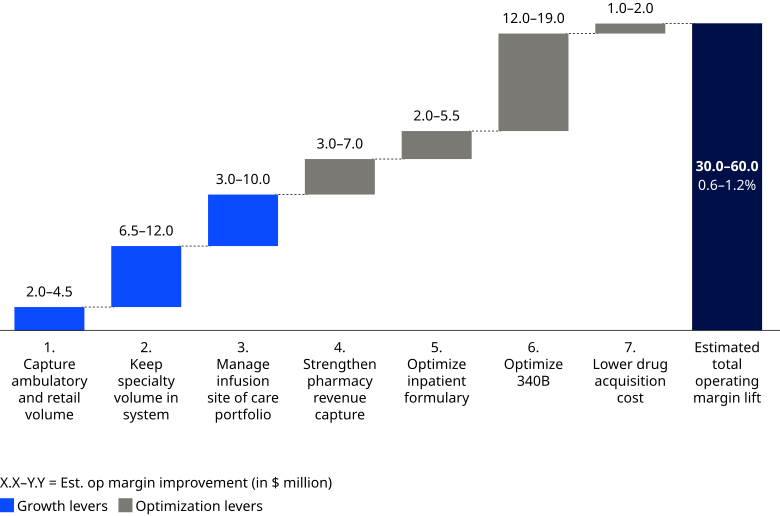
Specialty pharmacy is an area where health systems are gaining ground. Hospitals and health systems operate 27% of accredited specialty pharmacies, up from just 15% in 2017, helping to capture more high-value dispensing volume. Expanding this capability can reduce margin leakage to external PBMs and national specialty pharmacies while strengthening care coordination, medication adherence, and the patient experience.
Infusion strategy is equally important. Managing a diversified site-of-care portfolio that includes hospital outpatient departments, ambulatory infusion centers, and home infusion allows systems to retain complex patients such as oncology and transplant populations while aligning reimbursement and cost structures.
Improving 340B performance and revenue integrity in health systems
Maximizing pharmacy margin requires both growth and precision. Opportunities to capture revenue are often lost due to inconsistencies in coding, billing, and denial prevention, especially in infusion and specialty services.
At the same time, 340B strategies need to be modernized. The program reached $81 billion in covered drug purchases in 2024 — a 23% year-over-year increase — with hospitals accounting for 87% of total purchases. Specialty distribution channels represented more than 61% of 340B spending in 2024, underscoring the impact high-cost therapies can have on margins.
Health systems are also leaving meaningful 340B value on the table through fragmentation and manual workarounds.
There are several strategies to improve compliant capture of 340B encounters across care sites. First, standardizing encounter identification by building 340B eligibility criteria directly into electronic health record and ordering workflows, so eligible volume is captured prospectively. Second, deploying integrated analytics that reconcile purchasing, dispensing, and claims to surface missed opportunities, reduce duplicate discount risk, and maintain an audit-ready record. Last but not least, tightening contract pharmacy oversight by treating it as a managed portfolio, with routine audits, performance management, and network optimization decisions grounded in compliance, access, and economics. Taken together, an automated, rules-driven eligibility engine paired with an integrated analytics platform turns 340B from periodic clean-up into a repeatable, defensible capability.
Applying cost discipline to lower drug spend and improve margins
Growth alone won’t stem the tide of margin compression. Health systems also need to increase rigor when it comes to containing costs. That includes lowering net acquisition costs by optimizing partnerships with group purchasing organizations and expanding direct contract arrangements with drug manufacturers. Cost containment opportunities will begin to emerge as more branded drugs lose their patent exclusivity, opening the door to more use of less costly biosimilars and generics. Over the next decade, 118 biologics are expected to lose patent exclusivity necessitating the need to develop proactive biosimilar substitution programs and formulary governance frameworks to capture savings.
Reducing waste through improved inventory management is also critical. As is standardizing inpatient formulary decisions through enterprise pharmacy and therapeutics governance to manage high-volume drugs and reduce unnecessary variation.
Elevating pharmacy operations and expanding the role of pharmacists
Pharmacists represent one of the most under-leveraged clinical assets in healthcare. Ensuring they practice at the top of their license through medication therapy management, collaborative practice agreements, chronic disease management programs, and expanded ambulatory clinic services can improve patient outcomes, reduce avoidable utilization, and unlock new revenue streams. In many states, expanded pharmacist scope of practice is already enabling health systems to credential pharmacists as billing providers, creating new avenues for reimbursement.
Operational excellence efforts, including workflow redesign, performance management, and technology enablement further strengthen internal pharmacy performance and reduce structural cost. Automation of dispensing, clinical decision supported by artificial intelligence, and real-time inventory analytics are other levers that leading systems are pulling to impact margin.
Health systems that promote pharmacy to a core strategic platform, one that impacts margin resilience, patient retention, and clinical integration, will gain a competitive edge. They recognize that pharmacy can generate meaningful operating margin improvement while strengthening mission sustainability.
Additional Oliver Wyman contributors: Kim Babbin, Dale Brown, and Jae Shin