


North America's industrial goods sector has remained resilient through a period of pandemic disruption, inflation, geopolitical turmoil, and supply-chain pressures.
Technology-led subsectors such as semiconductor equipment, industrial software, and building technologies are outperforming more traditional parts of the industry, while North American companies are increasing their share of global industrial goods value.
At the same time, sustainability has become increasingly important, with regulatory requirements and customer demands pushing companies toward greater transparency and reduced emissions.
Technology-led industrial subsectors are outperforming
North American industrial goods companies achieved an average earnings before interest and taxes (EBIT) margin of 12.3% over the past 10 years. Performance, however, varies considerably between subsectors.
Semiconductor manufacturing equipment recorded an average EBIT margin of 22% and average sales growth of 19%, while industrial software achieved a 14% average EBIT margin and 11% average sales growth. By contrast, industrial conglomerates recorded average sales growth of less than 1%.
Building technologies, semiconductor manufacturing equipment, and industrial software have increased in value relative to the overall market capitalization of the industrial sector. These subsectors have benefited from major industry trends including digitalization and advances in factory and process automation.
North American industrial companies are gaining global share
North American companies perform better than the other regions in the study in both market value inflow and operational performance.
The US and Canada have a significant share of some of the industry's high-performing subsectors. Between 2021 and 2022, North American firms increased their share of the total global industrial goods sector's value from 33% to 37%.
Factors contributing to North American performance include lower energy costs, more streamlined regulation, flexible staffing strategies, and a stronger commercial, profit-driven mindset among management and stakeholders.
The regional shift also reflects the direct and indirect effects of policies including the Inflation Reduction Act, Infrastructure Investment and Jobs Act, and Buy American Act.
Sustainability reporting still lags industrial ambitions
Sustainability has become much more important to industrial firms, driven in part by regulatory disclosure requirements and increasing customer demand for transparency about products' carbon footprints.
Companies that set Scope 1 and 2 emissions targets between 2018 and 2022 reduced their emissions by 24% over that period. However, only 60% of firms were reporting their Scope 1 and 2 emissions, based on 2021 data, the last year with full sample availability.
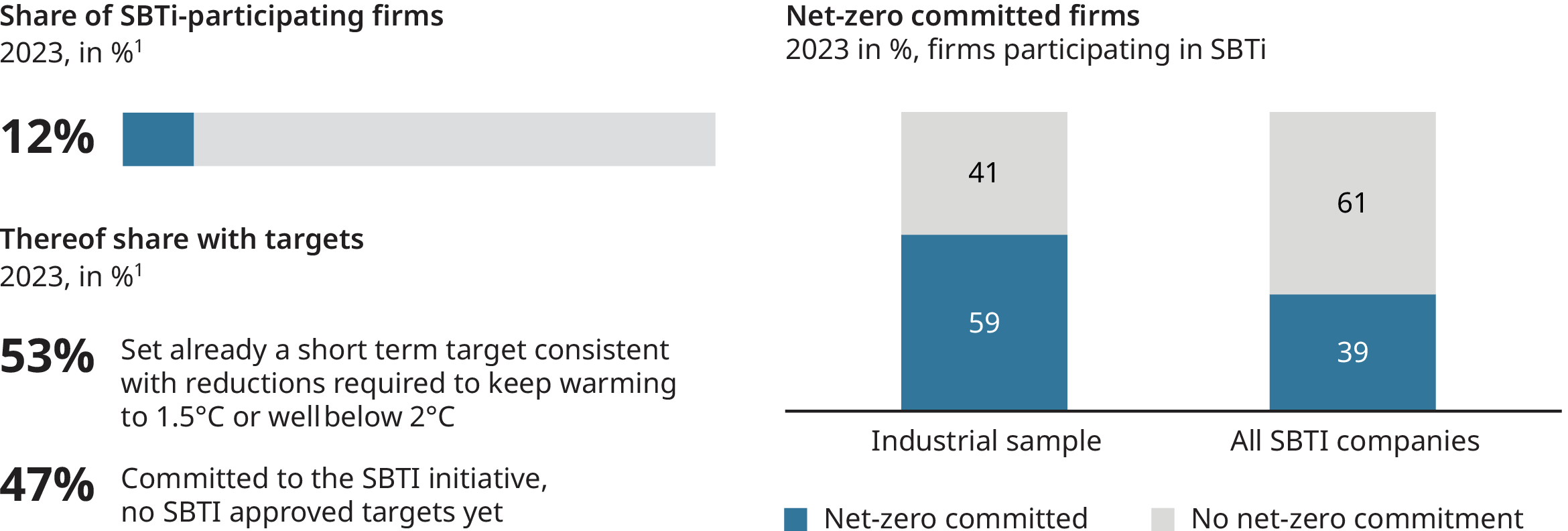
Around 60% of industrial firms in the sample report Scope 1 and 2 targets. Only 12% participate in the Science Based Targets initiative (SBTi). Of those, 53% have an approved 2030 target aligned with the Paris Agreement goal of limiting the average global temperature increase to 1.5°C above preindustrial levels. In addition, only 59% of SBTi-participating firms have committed to net-zero greenhouse gas emissions.
Industrial firms need to balance transformation and flexibility
The industrial goods sector has a strong mid-term future, with opportunities including artificial intelligence, low-carbon technologies, and new markets.
At the same time, inflation, geopolitical turmoil, and potential recessions pose major risks. Success will depend on balancing bold, transformational moves that align with long-term structural trends with the strategic flexibility needed to adapt to potential disruptions.
The coming years will be pivotal for the sector.
This report provides insights into the North American industrial goods sector, based on an analysis of more than 1,000 publicly listed companies worldwide and an online survey.
