


Across the Middle East, traffic congestion is consuming hours of daily life. In Riyadh and Dubai, commuters spend an average of 40 to 60 hours each year stuck in gridlock, while in Istanbul, drivers lose over 100 hours due to traffic delays, according to data from INRIX and TomTom.
This scenario plays out in other major cities across the globe and isn’t just an inconvenience; it hampers productivity, harms public health, and erodes quality of life. It’s also costly, draining more than US$500 billion from the global economy annually, as outlined in this report.
These trends are reversible. With smarter planning, fairer pricing, and the effective use of innovative technology, Middle Eastern cities can transform congestion from a daily burden into a catalyst for more livable and efficient urban environments.
While governments across the region are already investing in various transportation initiatives, such as new rail and bus lines, infrastructure alone won’t solve the congestion crisis. Lasting improvement requires strategies that directly influence how, when, and why people travel. Combining comprehensive planning, stakeholder alignment, rigorous policy design, and sustained investment can help cities move beyond incremental fixes toward smarter traffic management.
Shaping driver behavior through smarter road pricing
Municipalities around the world have introduced congestion charges as a means to manage traffic in dense urban centers, with mixed results. In London, for instance, a 22-year-old fee was credited with reducing congestion in the charge zone by 30% within a year, reducing accidents by nearly half, and generating £122 million annually for reinvestment in public transport. The city, however, still ranks as the most congested in Europe and fifth globally according to INRIX, underscoring that pricing mechanisms are most effective when combined with broader, well-designed mobility strategies. Singapore and Stockholm have achieved success as well, using dynamic tolling systems that raise prices during peak hours.
Dubai’s Salik system shows that congestion pricing can work in the Middle East, too. Since its launch in 2007, it has eased congestion on Sheikh Zayed Road and become a profitable operation with EBITDA margins above 80%. Similar measures could be applied in Riyadh. Our analysis suggests that toll gates on major corridors could generate US$500 million to US$750 million a year, while a broader congestion-charging zone could raise US$1.75 billion annually. Those funds could be reinvested to strengthen public transport, maintain infrastructure, and support sustainable mobility initiatives.
A practical framework to reduce urban traffic congestion
Congestion pricing is not only a revenue mechanism; it’s a tool for influencing travel behavior. For such systems to succeed, they must be perceived as fair, transparent, and purposeful. People are more likely to accept change when the rules are clear, protection exists for lower-income drivers, and when they can see that the money collected is being used to make travel faster, cleaner, and more reliable for all.
Our framework lays out a practical roadmap for cities to manage congestion through smarter systems, technology, and incentives rather than endless construction and road expansion. It’s built on four core pillars that together create the foundation for lasting, effective urban mobility.
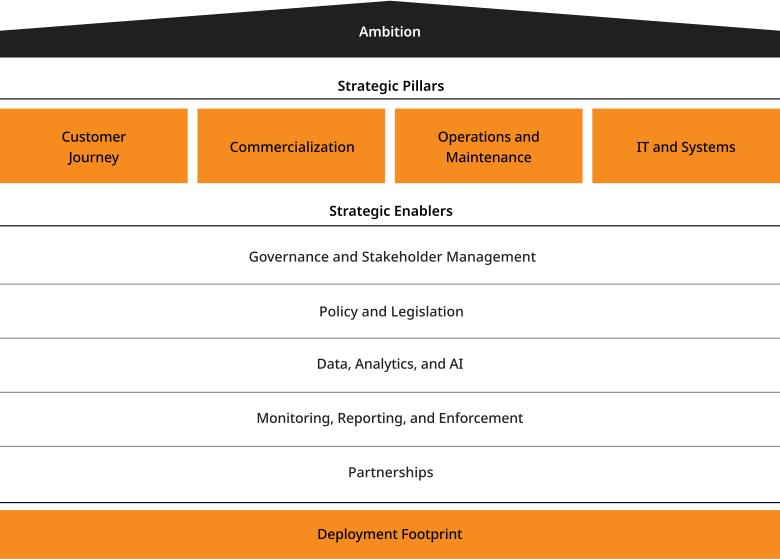
A well-designed customer journey makes compliance effortless
The first focus is on the customer journey: how people interact with the system on a day-to-day. Drivers are more likely to comply when they can register, pay, and receive updates through a single, intuitive platform. Reducing friction in the customer journey builds trust and turns participation into a habit, helping people view the system as a service rather than a penalty.
Fair and flexible commercialization models change travel choices
Having a transparent pricing policy is also essential. Pricing that reflects time, distance, and demand encourages more thoughtful and deliberate travel choices, such as avoiding peak hours, ride-sharing, or switching to public transport. Dynamic pricing allows systems to remain responsive while balancing between efficiency and everyday travel needs.
Reliable operations and maintenance build credibility and confidence
Strong operational performance underpins effective congestion management. Accurate toll collection, consistent enforcement, and clear accountability — whether delivered by public entities or private partners — reinforce confidence that the system works as intended.
Advanced IT and data systems keep cities learning and adapting
Secure, data-driven systems enable cities to monitor conditions, detect issues, and adjust operations in real time. Artificial intelligence and analytics make it possible to anticipate congestion, model scenarios, and continually improve how roads and transportation networks function.
These pillars are supported by five critical enablers: strong governance, clear legislation, reliable data, ongoing monitoring, and collaboration between public and private sectors. Together, they offer a plan cities can implement to deliver effective congestion management within two years, starting with pilot projects to test pricing and technology before expanding citywide.
The Middle East can lead a new era of urban mobility built on thoughtful design rather than perpetual expansion. The challenge now is a shift in mindset: to stop adding lanes and start changing behavior.
