


For nearly eight decades since the Bretton Woods agreement of 1944, central banks and financial regulators have been the custodians of monetary order. They have managed money-issued by the state, as well as money created by the banks they supervise. That order is now being tested by the rise of stablecoins, privately issued digital money, forcing central banks and regulators to revise their monetary policies. Their responses will define the future global monetary order.
What is at stake is not just innovation in payments, but control over money itself — including how policy is transmitted, how crises are managed, and whose currency anchors everyday economic life.
Stablecoins are privately issued digital tokens. They move across borders at internet speed, circulate through apps rather than banks, and promise stability without reliance on the state.
The growth of US dollar-backed stablecoins signals how quickly private digital money is expanding globally — and how fast it could move into the mainstream under permissive regimes. If households and businesses can hold and move digital dollars as easily as local currency, familiar tools of monetary management start to lose traction. The International Monetary Fund (IMF) has warned that traditional policy levers may become strained in a world where money is more digital, mobile, and increasingly issued by private actors.
Emerging stablecoin use cases — and the policy pressure they create
Stablecoins first thrived because they let crypto markets move funds without returning to the banking system. Today, stablecoins are increasingly being used to pay, transfer, and store value. For regulators, these use cases are not just technological innovations — they are the channels through which stablecoins move from the periphery into the core of monetary and payment systems, forcing policy responses sooner than many frameworks were designed for.
Retail payments are one early signal. In countries where confidence in local currencies has eroded, stablecoins are showing up in everyday transactions. In one Latin American country, where annual inflation has recently exceeded 100%, stablecoins are now accepted by a growing number of online retailers — more than 100 to date.
Cross-border transfers are another growing application. Remittances and trade payments have long been constrained by high fees and slow settlement. In parts of sub-Saharan Africa where access to foreign currency is limited, stablecoins now account for a growing share of incoming remittances, particularly during periods of inflation and FX volatility. This shift is no longer marginal: IMF analysis estimates that cross-border stablecoin transaction volumes reached around US$2 trillion in 2024.
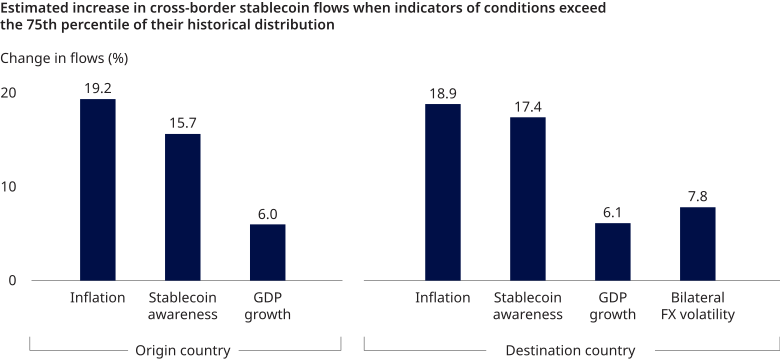
A further use case for stablecoins is as a store of value. In economies with high inflation or capital controls, stablecoins can function like foreign currency accounts that are accessible by phone, beyond the limits of domestic banking.
Stablecoins pose a major risk to monetary sovereignty
As stablecoins move from niche tools to everyday financial instruments, their implications extend beyond payment efficiency — reaching into the heart of monetary control. While many operational and conduct risks have been documented by international standard-setting bodies such as the BIS and through joint IMF-FSB analysis, a deeper concern is monetary sovereignty. That risk can manifest in three ways.
- Reduced monetary policy traction. The IMF and some central banks warn that large shifts into foreign currency stablecoins can weaken policy transmission. Central banks can steer inflation and growth through interest rates and reserves, but those tools have limited effect on money that sits outside domestic financial systems.
- Pressure on banks. Stablecoins compete with deposits. If households and firms move funds into foreign currency stablecoins for convenience or perceived safety, banks may face higher funding costs and lower margins. The European Central Bank and the Bank of England have both noted that substitution could weaken banks’ resilience.
- Crisis dynamics. During stress events, stablecoins can amplify capital flight. If confidence in the local currency falls, people can shift instantly into a foreign-denominated alternative, adding pressure to exchange rates. Large-scale redemptions can also transmit instability through rapid sales of reserve assets into bond and money markets.
History matters. Past episodes of currency substitution often unfolded over years or decades. In a digital age, similar transitions could occur within months. Stablecoins may compress the traditional timeline of dollarization, accelerating both its benefits and its costs.
Three policy choices for regulators that will shape the future of stablecoins
The report frames the future of stablecoins as a policy choice shaped more by regulatory strategy than by technology. Three broad approaches are emerging.
1. Ban — fortress money
Some jurisdictions are moving to ban stablecoins in domestic payments and savings, or to constrain them through stringent licensing requirements. China and several Gulf states have outlawed crypto trading and stablecoin issuance. This approach can protect monetary sovereignty and preserve capital controls, but it can also push innovation offshore and raise enforcement costs.
2. Compete — state-led alternatives
Other jurisdictions are choosing to compete by building domestic alternatives. Their goal is to offer speed and convenience through safer, regulated rails, such as a central bank digital currency or a fully reserved domestic stablecoin regime. Japan’s 2023 framework, overseen by the Financial Services Authority, allows only licensed banks and trust companies to issue fully reserved yen-pegged stablecoins
3. Adapt — Managed integration
A third group is adapting by integrating stablecoins into regulatory frameworks. In the UK, HM Treasury and the Bank of England are bringing stablecoins into the regulatory framework, requiring authorization as well as capital, liquidity, and robust redemption arrangements.
These policy choices shape future monetary paths. Under tighter restrictions, stablecoins may remain in niche coexistence — limited in domestic embedding, even as cross-border and offshore use expands — although enforcement gaps can blur onshore and offshore use over time. Where authorities compete or cooperate through domestic digital money and shared infrastructure, a stable integration model can emerge with multiple digital monies operating under clear guardrails and common standards. Where tolerance becomes default, and oversight replaces restraint, foreign currency stablecoins will likely move deeper into daily finance and reduce monetary independence.
Stablecoins are forcing central banks and financial regulators to make strategic choices about money. A fragmented patchwork of rules, standards, and payment networks could undermine trust in money and in the institutions that govern it. Trust remains the ultimate anchor of any store of value or payment mechanism. How authorities respond to the challenge of stablecoins will shape not only domestic monetary outcomes but also the coherence of the international monetary system itself.
