


Greece's current economic recovery presents an opportunity to harness impact investing for meaningful change and to advance the country’s sustainable development agenda. Impact investing can fulfill a critical need for funding impact-driven solutions and driving long-term change at scale, while also achieving sustainable financial returns.
For maximum effect, capital should be mobilized from the wider investment community toward ventures that yield positive environmental and/or social outcomes, notably by integrating the principles of impact investing into traditional investment strategies.
However, Greece’s impact investing market is largely undocumented, leading to a significant mismatch between the available funds and the financing reaching impact-driven businesses.
Our 2025 “Greek Impact Investing” report represents one of the first attempts to map out the opportunities in Greece’s emerging impact investing sector. It explores its potential to drive meaningful social, environmental, and economic benefits across the region.
Forecasting growth in Greece’s impact investment market
In the report, we analyzed the dynamics between the demand and supply of impact capital, focusing on the estimated funding needs of early-stage impact-oriented startups and the capital available from impact-oriented funds.
We found that around 200 impact-oriented startups in Greece were seeking between €130 million and €180 million in funding in 2024. By 2030, we project the cumulative total demand could rise to between €3 billion and €5 billion as new ventures emerge and existing startups seek further investment.
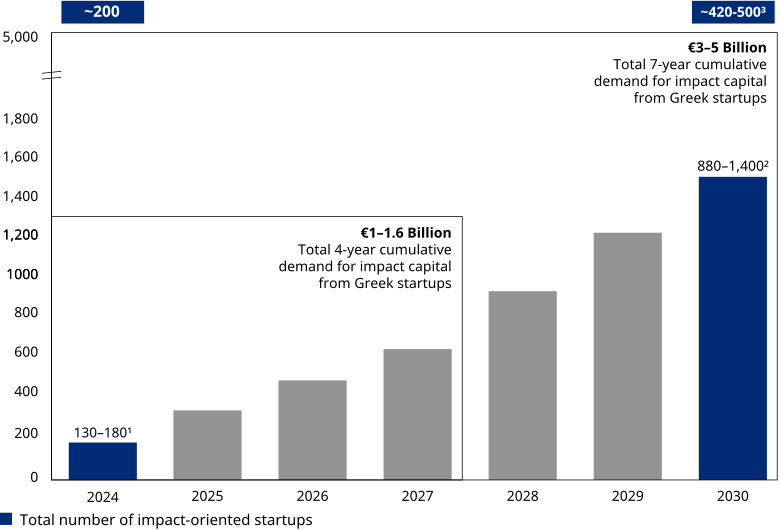
Some companies may struggle to secure financing, so not all of this demand is expected to be met. But the ecosystem’s capacity to support startups will improve as the market matures and becomes more sustainable.
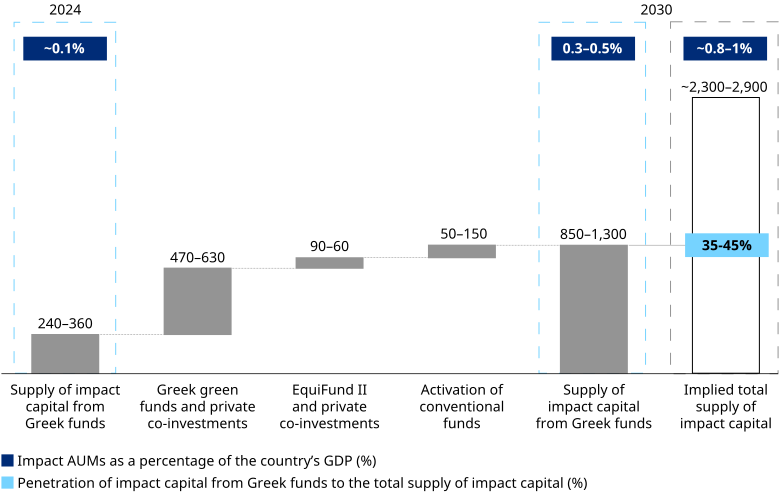
On the supply side, we evaluated the private capital market, where 11 impact-oriented funds were established between 2020 and 2024. These funds currently manage between €240 million and €360 million, equivalent to about 0.1% of Greece's GDP.
However, the deployment of this capital has been limited. Of the 27 impact-oriented companies receiving funding from Greek impact-oriented private capital funds, impact-first investors, and their co-investors, the 22 for which data were available collectively secured little more than €35 million to €40 million in impact-focused investments between 2020 and 2024.
Address challenges to grow Greece’s impact investment ecosystem
Insights from key market participants reveal several roadblocks, including the absence of standardized definitions and classifications of impact investing, a lack of transparency in impact reporting, limited deal flow, and misalignment between investor goals and available opportunities.
Collaboration among stakeholders — investors, entrepreneurs, and market enablers — will be essential to realize the market’s potential. Together, these actors should establish a universal impact measurement framework and impact-driven definitions, support companies’ investment readiness, and foster connections between ventures and investors. They should also advocate for public sector support and fiscal systems that incentivize the generation of positive externalities.
If the necessary conditions and support mechanisms are established, investment from a broader range of investors will supplement private impact capital. These investors will include not only new impact-oriented funds but also conventional private capital funds, corporations, financial institutions, pension funds, family offices, angel investors, and international private capital. We estimate that the total supply of impact capital sourced from private equity and venture capital funds could reach approximately €850 million to €1.3 billion by 2030.
Confirm optimism for growth in Greece's impact investment market
Recent 2025 market highlights confirm this optimistic trajectory. By the end of 2025, the Greek impact investing market is anticipated to welcome three new impact-oriented funds supported by the European Investment Fund and the Hellenic Development Bank for Investments. Together with a significant capital top-up to an existing fund, these initiatives are projected to mobilize between €100 million and €110 million of impact capital.
At the same time, the Hellenic Innovation and Infrastructure Fund — Growthfund’s newly established sovereign investment vehicle, seeded with €300 million to co‑invest in priority areas such as renewables, digital infrastructure, and the circular economy, among others — further widens the pipeline for public-private mobilization.
Regulatory developments are also advancing, with increased appetite from policymakers to clarify the definition of impact investors and reinforce sustainability disclosure standards. Market participants are becoming more active, reflected in the launch of Greece’s first dedicated impact investing report by the Hellenic Impact Investing Network. These signs of momentum underscore the maturation of the Greek impact investing ecosystem and its readiness for accelerated growth.
By directing capital to impact ventures, Greece can make impact investing a core component of its financial industry, unlocking new opportunities for investors and supporting progress toward the country’s sustainable development goals. Impact investing can also stimulate economic growth, promote social equity, and drive environmental sustainability, ultimately contributing to a more resilient and inclusive society.
