


Telecommunications operators face increasing pressure as both revenues and profitability shrink, while proprietary network infrastructure becomes costlier and less agile. Migration to the public cloud is now a decisive lever, enabling leading operators to reduce costs, boost innovation, and strengthen resilience. Early movers are cutting total cost of ownership by up to 30%, while also enhancing cybersecurity and safeguarding data sovereignty.
This transition shifts telcos from capital-heavy physical setups to scalable, on-demand cloud environments. Network functions move from fixed regional hardware to software running on elastic, shared public cloud resources. This change unlocks a range of benefits by transferring operational risks to cloud providers.
Although many operators have virtualized network functions on private or managed clouds, moving fully to public clouds is a bolder step with significant regulatory, organizational, and technical challenges — along with equally significant rewards.
Transitioning telco networks to flexible, cloud-based infrastructure
The migration of telco networks to the cloud is the latest chapter in a longer evolution. In earlier mobile network generations, network functions such as session control, user management, and policy enforcement ran on dedicated hardware installed within network exchanges and radio base stations. These physical network functions (PNFs) provided critical services, but at high cost and with limited flexibility.
The advent of 4G and 5G accelerated a transition toward virtual network functions (VNFs). VNFs decouple hardware from network software, enabling operators to run network functions on general-purpose hardware that’s delay-tolerant, scalable, and easier to upgrade. Most operators have already virtualized core components, but a large contingent of legacy physical network assets remain.
Cloudification represents the next step. Hosting VNFs on cloud infrastructure — private, managed edge, or public — introduces operational agility, scalability, and better resource utilization. Public cloud denotes a shared, provider-managed infrastructure and is not limited to hyperscalers. National or regional "sovereign cloud" providers are increasingly vital, offering cloud services within local jurisdictions to meet mounting data sovereignty and regulatory requirements.

Ensuring compliance amid escalating data sovereignty demands
Rising global geopolitical tensions and complex data sovereignty laws present operators with daunting migration challenges. The regulations demand strict controls on data location, processing, and access, extending far beyond traditional regional boundaries. Merely locating data centers domestically is not enough; governments seek enforceable guarantees on data custody, encryption, operational transparency, and even local ownership or joint control over data infrastructure.
Sovereign cloud partnerships allow telcos to leverage cloud agility while maintaining full control over sensitive data, reducing regulatory risk and enabling faster approvals. Operators can thus shift network functions to public cloud environments that align with national security demands, a critical enabler for large-scale migrations.
Key benefits of migrating network functions to the public cloud
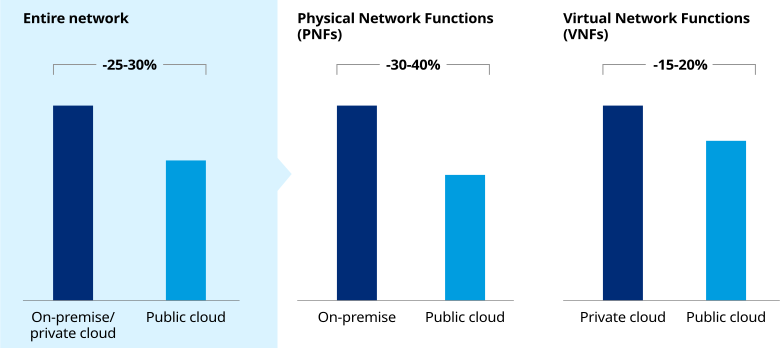
Public cloud migration delivers transformative cost and operational benefits. Anecdotal reports from early adopters indicate up to 30% total cost savings, with 40% for physical network functions. These stem from three core drivers reshaping telco operations:
Elastic scalability drives cost efficiency: Cloud platforms allow real-time, dynamic allocation of resources, replacing overprovisioned legacy hardware designed for peak use. This elasticity enables 3% to 5% incremental annual cost savings by optimizing resource use and avoiding idle capacity.
Reliability improves through risk and security shift: Cloud providers assume responsibility for infrastructure resilience and cybersecurity. That lowers operators’ exposure to cyber threats and lets them focus on securing redundant, geographically diverse physical-to-cloud connectivity to reduce the risk of service interruptions from local outages.
Network management becomes more efficient and agile: Cloud-based labs enable remote software testing, reducing deployment time and logistical overhead. In our experience with clients, operators have shortened time-to-market by up to 30%, while cloud automation cuts backup storage costs by 60% to 70%, freeing resources for innovation.
Strategic solutions to navigate migration successfully
The migration journey involves more than technology upgrades — it demands bold, comprehensive actions that align partners, build internal capabilities, and secure organizational commitment. Operators that pioneer cloud migration report that tackling partnership complexity, skills gaps, and commitment challenges is essential to fully unlock cloud benefits.
Partner with experienced vendors and cloud providers
Forming effective partnerships with both network vendors and cloud providers is among the most immediate challenges. Many vendor network functions are still in the process of being optimized for public cloud environments; early testing phases often reveal stability gaps or incomplete integration. Successful operators use phased migrations, starting with controlled labs or limited field tests, only scaling once stability is proven. This iterative approach allows time to address issues and ensures smooth scaling.
Clear role definitions and ongoing collaboration are vital. Teams must know who handles operational support, security, and performance as responsibilities shift. Choosing systems integrators and partners that combine technical competence with flexibility to work through evolving challenges will boost migration resilience and speed.
Build internal cloud capabilities
Migrating to cloud-native networks requires a marked shift in skills and culture. Teams accustomed to physical infrastructure must master cloud principles, automation, and orchestration. Without investment, skills gaps sap efficiency and limit progress.
Leading operators embed hands-on training and progressive learning to transition teams from vendor-led to fully autonomous cloud management. Appointing migration leads and fostering a culture of ownership encourages teams to take proactive responsibility.
Secure organizational commitment
Achieving alignment across business units and leadership is the most critical and challenging success factor. Partial or prolonged hybrid migrations introduce complexity, drag, and risk, diluting cloud benefits.
Operators with successful transitions develop comprehensive, clear roadmaps that sequence migrations, explain rationale, and set milestones. Transparency about costs — especially temporary overlap and redundancy — is key to securing executive sponsorship. Continuous communication reinforces commitment, enabling disciplined cutovers that maximize reliability and cost savings.
Design resilient connectivity
Cloud providers deliver reliable, fault-tolerant core infrastructure, but operators remain responsible for resilient physical network connections. Investments in geographically diverse, redundant links between physical assets and cloud infrastructure ensure survivability against local outages, maintaining continuous service.
Strategic planning is required to balance cost and reliability, as this connectivity is the final link that sustains seamless cloud operation and preserves service quality.
Embed security and compliance early
Data sovereignty and cybersecurity are central to migration strategy from day one. Sovereign cloud providers that offer enforceable controls on data residency, encryption, access segregation, and audit transparency underpin regulatory compliance and operator trust.
Security measures should be baked into operational processes and architecture early to avoid costly retrofits. This commitment also reassures stakeholders while protecting networks against increasing cyber threats.
How telcos win with public cloud through cost, speed, and security
The public cloud is fast becoming the backbone of modern networks. The strategic question is not whether to migrate, but how. Operators that delay will face rising unit costs, slower innovation, and shrinking flexibility. But those that move now — sequencing highest-ROI workloads first, aggressively decommissioning legacy, and measuring progress through cost, reliability, and speed — will secure early savings, unlock growth, and widen the competitiveness gap.