


Following last year’s Powering Your Sustainability Through Procurement, report, this year’s research set out to understand how far procurement has progressed on the Environmental, Social, and Governance (ESG) agenda. More than 300 Chief Procurement Officers across major industries shared their perspectives, offering a global view of where companies stand today and where the biggest gaps remain.
The state of ESG ambition in procurement
Almost all surveyed companies have now defined their ESG ambitions at a strategic level. Many have begun embedding these ambitions into procurement agendas, and the most advanced organizations are translating them into quantitative KPIs, cascading them to buyers, and integrating them into processes and tools.
Yet progress is uneven. A significant share of procurement teams still operate primarily on traditional metrics —cost, quality, and service level — rather than ESG criteria. This gap is most pronounced in the Environmental dimension, which continues to lag behind Social and Governance.
Environmental maturity must accelerate to close the ESG maturity rate
While carbon emissions have received substantial attention, more than half of companies have not set Environmental objectives for procurement beyond carbon. Areas such as air and water protection, biodiversity, and circularity remain underdeveloped.
The report highlights that companies making the most progress have invested in robust baselines, often using methodologies such as the Science Based Targets initiative (SBTi) to quantify Scope 3 emissions and guide long‑term decarbonization plans.
How leaders are embedding ESG in procurement
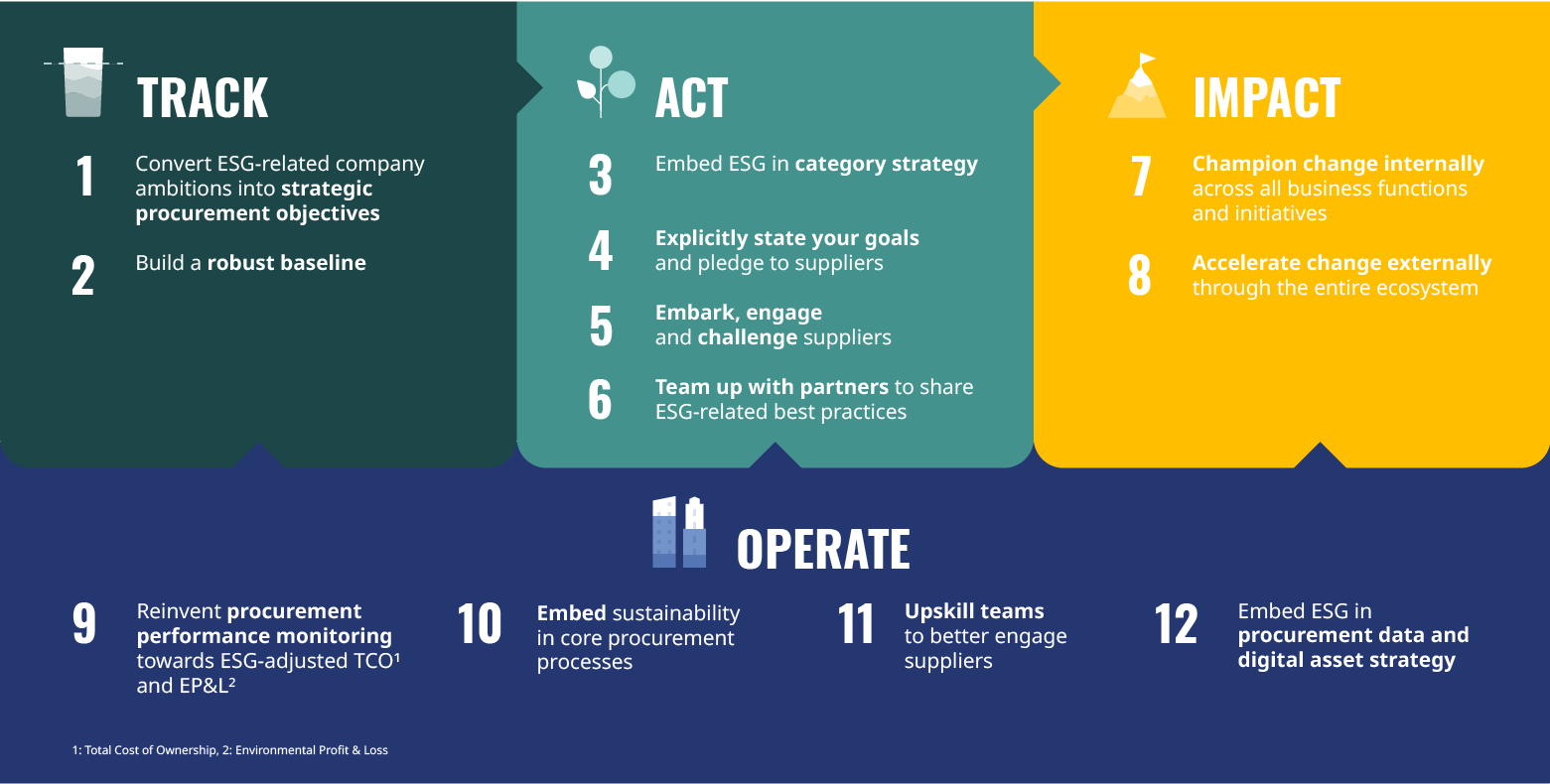
The research identifies several practices that distinguish ESG leaders:
- Quantitative integration of ESG into category strategies, with some companies making ESG the primary decision driver for key categories.
- Clear supplier pledges, supported by differentiated objectives and consistent communication.
- Structured supplier engagement, including audits, training, and long-term partnerships to drive change.
- Cross-industry collaboration, such as participation in alliances like the Global Battery Alliance or CEFLEX, to address systemic challenges.
- Internal ESG leadership, where procurement teams champion sustainability initiatives across the business.
Data, technology, and skills gaps slow ESG progress
Despite growing expectations, many procurement teams lack the ESG-related data and digital tools needed to track progress. Leaders are increasingly adopting ProcureTech solutions, but the report warns against pursuing “perfect data lakes” and instead recommends focusing on high-quality, high-impact data.
Upskilling remains another critical gap. ESG requires new capabilities—from understanding regulatory shifts to designing sustainable supply chains—yet most companies have not invested sufficiently in training category managers and buyers.
What procurement must do to accelerate ESG maturity
The report concludes that procurement is uniquely positioned to drive ESG transformation across the value chain. But to do so, teams must:
- Move beyond compliance toward impact-driven decision-making
- Prioritize Environmental dimensions beyond carbon
- Strengthen supplier partnerships and ecosystem collaboration
- Invest in data, digital tools, and ESG-specific skills
- Shift procurement performance monitoring toward ESG-adjusted metrics
Sustainable procurement is no longer optional — it is central to delivering a company’s ESG agenda and shaping long-term resilience.
Originally published in September 2022.
