



Health insurers gained some regulatory relief last year when federal regulators paused enforcement of the 2024 final mental health parity rule. The freeze came in response to a lawsuit challenging the rule and to a separate executive order requiring all agencies to review the impact of regulations on businesses.
But that doesn’t mean insurers can or should rest on their compliance. In their 2025 Report to Congress, the Departments of Labor (DOL), Health and Human Services, and Treasury noted that they are still enforcing rules promulgated in 2021 and remain focused on enforcing limitations that affect access to mental health and substance use disorder benefits. Failure to comply with those regulations carries significant implications for the bottom line, public trust, and patient care.
Health plans need to stay vigilant in their compliance efforts. And if they do get a letter of inquiry from DOL, it’s vital that they have a disciplined approach to navigate through the process with confidence.
Why mental health parity compliance is now critical
Attention to mental health parity has been building for decades, from early federal requirements in the 1990s through the Mental Health Parity and Addiction Equity Act (MHPAEA) of 2008 and its subsequent extensions. MHPAEA requires most group health plans and insurers to ensure that mental health and substance use disorder benefits are no more restrictive than comparable medical and surgical benefits. The law applies to financial requirements, quantitative treatment limits, and non-quantitative treatment limits (NQTL) such as prior authorization rules, network standards, and reimbursement methodologies.
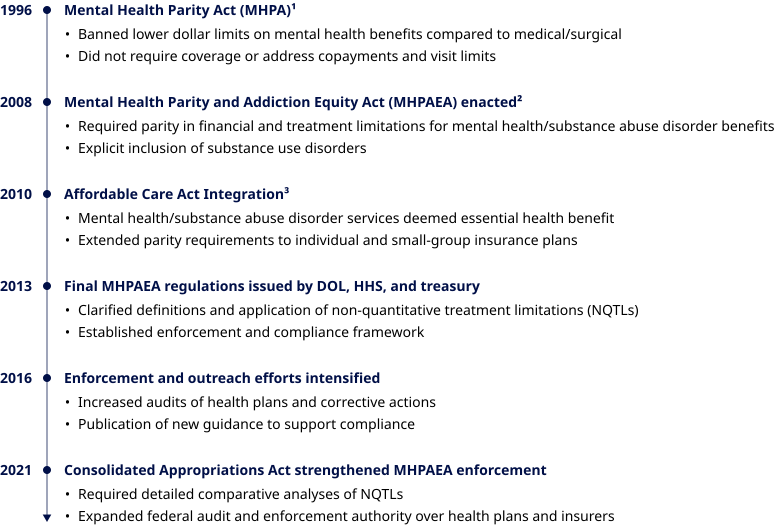
The introduction of NQTLs gave DOL a new enforcement focus, which intensified following the enactment of the Consolidated Appropriations Act (CAA) of 2021, which requires plans to prepare comparative analyses for all NQTLs. Regulators have zeroed in on network adequacy and network composition, exclusion of key mental health and substance use disorder treatments, prior authorization, concurrent review, network admission standards, and reimbursement methods for out-of-network care. Between February 2021 and July 2023, DOL issued 199 initial letters requesting comparative analyses covering more than 480 NQTLs — often the formal start of a regulatory audit. DOL then sent 183 insufficiency letters addressing more than 330 NQTLs, identifying specific deficiencies or missing information that must be corrected to avoid a finding of noncompliance. Over the same period, violations tied to insufficient NQTL analyses accelerated more than in other areas of the law. The 2025 MHPAEA Report to Congress shows that the DOL has sustained its enforcement activity, issuing final determinations of noncompliance to five plans for seven NQTLs. The Centers for Medicare and Medicaid Services (CMS), which serves as the main MHPAEA enforcer in Texas, Wyoming, and Missouri, also issued final determinations of noncompliance to six plans for 10 NQTLs.
Working through this experience can be daunting for health plans. Many operate in markets where access to mental health services is strained. Engagements with regulators can escalate to multiyear affairs due to repeated information requests and corrective actions, and many of these plans manage MHPAEA with lean teams due to staffing and budget constraints. Plans also face operational disruption, and in some cases, public findings of non-compliance.
Plans have struggled to meet the DOL’s bar for comparative analyses
In its annual report to Congress each of the past four years, DOL reported that few of the initial NQTL comparative analyses were sufficient to demonstrate compliance. This suggests that most plans have not developed a competency around MHPAEA compliance. Common comparative analysis issues identified in DOL feedback and in our work with health plans include:
- Insufficient explanation of NQTL factor sourcing; plans must state where factors were derived, such as clinical guidelines and federal or state law
- Vague descriptions of how NQTLs are applied; plans must describe the step-by-step process to apply NQTLs, including teams involved, timelines, and criteria used
- Lack of comprehensive comparative application data and operational data; plans must provide sufficient data to validate their statements about parity
How health plans can build a strong parity response
Organizations need to follow a few design principles externally and internally to ensure they maintain and sustain compliance.
External approach to demonstrate MHPAEA compliance
Proactively write a comprehensive, structured parity analysis and corrective action plan if applicable, rather than a reactive or piecemeal response. For each NQTL, conduct a structured, end-to-end review of process design, standards and criteria, decision-making frameworks, and supporting documentation, and document corrective actions to demonstrate compliance.
Plans should also proactively engage with DOL by approaching interactions transparently and non-defensively, with a focus on demonstrating good-faith effort and operational understanding. It is vital to communicate an end-to-end analysis approach to set expectations.
Internal approach to maintain and sustain compliance
Deploy a clear internal operating model to respond to DOL inquiries and execute action plans. This includes standing up a cross-functional response team across business operations, compliance, legal, and external advisors with clear roles, responsibilities, and leadership alignment toward compliance. Leaders need to create a culture of compliance that treats MHPAEA as an ongoing operational responsibility rather than a one-time regulatory exercise. Ongoing measurement and monitoring to continuously track measurable parity outcomes and proactively identify issues is also key and requires embedding reporting into forums where issues can be quickly addressed or escalated.
For most health plans, the highest-impact first moves are: build a single, high-quality comparative analysis for one high-risk NQTL, appoint a cross-functional MHPAEA lead team, and stand-up parity monitoring in existing executive forums.
Mental health parity capabilities cannot be delayed
The temptation for many plans, especially those not currently under active investigation, is to treat MHPAEA as a future risk. That could be a costly assumption. DOL has publicly stated that it will continue pursuing aggressive enforcement of parity requirements.
If plans are found non compliant, they risk financial penalties and corrective actions, such as remediating past claims, implementing operational changes, and meeting regulatory timelines for documentation. In addition to financial exposure, plans face significant reputational and membership consequences, including negative publicity, loss of provider and employer trust, and the obligation to notify members of non compliance, which can damage retention and brand value. There is also an opportunity cost of time spent scrambling to assemble documentation under short deadlines, which crowds out more strategic work.