


-

-

-

-
 Link copied
Existing and new technology
3 Key Strategies To Manage Indirect Spend In Consumer Goods
Successful management for effective optimization
By Rainer Münch
-
-
-
- Link copied
In challenging times, retailers and consumer goods companies are focused on enhancing operational efficiency and reducing costs. However, one area that often receives insufficient attention is indirect spend, which often represents 6% to 8% of revenues. Despite its significance, indirect spend is rarely scrutinized in the same way as costs like labor or direct procurement costs, making it a major untapped source of savings — even for companies that have attempted to control their expenses.
Many organizations resort to temporary cost-cutting measures or simple budget adjustments, such as restricting travel or reducing marketing budgets. These tactics are often seen as arbitrary by employees and fail to produce sustainable savings. As a result, spending patterns remain unchanged, leading to a rebound in costs.
Existing and new technology
Opportunity, Excitement, and Strategy Drive Technology Initiatives
Read More
Only a small number of companies have created a comprehensive indirect spend operating system, which provides a competitive advantage by generating considerable savings while leveraging supplier innovations to enhance commercial effectiveness and customer experience.

Existing and new technology
Opportunity, Excitement, and Strategy Drive Technology Initiatives
Leaders emphasize the need to balance enthusiasm about the future of technology with a focus on practical solutions.
We often hear words such as challenging and disruptive when food industry leaders discuss today’s technology strategies.
But there is also the positive emotional charge that comes when navigating through unchartered territory.
“This is an exciting time to be involved with grocery retail and technology,” said one food retail executive interviewed for FMI’s The State of Technology research report.
The comment underscores a perspective that technology is driving new opportunities for the food industry. Food retailers and suppliers are making investments in many existing solutions and experimenting with new ones.
The newest opportunities lie in emerging technology and automation, including artificial intelligence, that offer dramatically new capabilities. Much of the interest stems from the need to find efficiencies and productivity in the face of tight profit margins, higher costs, labor challenges and supply chain unpredictability.
The sense of excitement is balanced by the recognition that leaders need to carefully pick and choose technology investments to maximize ROI both for business and consumer-facing applications. Leaders say it’s important to be strategic about separating meaningful opportunities from hype.
In 2024, food retailers devoted an average of 1% of their total sales — more than $10 billion — to their technology budgets. Food suppliers spent a greater share of sales (1.5%) on technology.
Here are a few ways the food industry is making investments toward business advancement, based on FMI research:
- Forty-seven percent of food retailers and 93% of food suppliers use artificial intelligence (AI), according to The Food Retailing Industry Speaks. Meanwhile, 26% of retailers and 57% of suppliers are using Generative AI for internal content creation.
- Food retailers are incorporating a wide array of technology into their organizations. Companies have been focusing on the growth of electronic shelf labels/tags, along with technology to aid in product traceability, and for fresh inventory and demand/production planning.
- Retailers are turning digital shelf space into revenue-driving ecosystems. The Evolution of Retail Media, from FMI, NielsenIQ and Think Blue, relays that 73% of food retailers plan to grow their media networks within two years.
Leaders interviewed by FMI emphasize the need to balance the enthusiasm about the future of technology with a focus on practical uses, such as building incremental sales, attracting more customers or improving efficiencies.
“Start with what problem you’re trying to solve through AI and other emerging technology,” said a retailer. “You can’t do everything, but it’s important to conduct experiments.”
In June 2026, FMI is hosting GroceryLab, the food industry’s first cross-functional, behavior-shifting forum to reimagine how we serve the shopper in a world that moves at the speed of technology.
For more resources from FMI in technology, visit the technology topic pages of fmi.org.
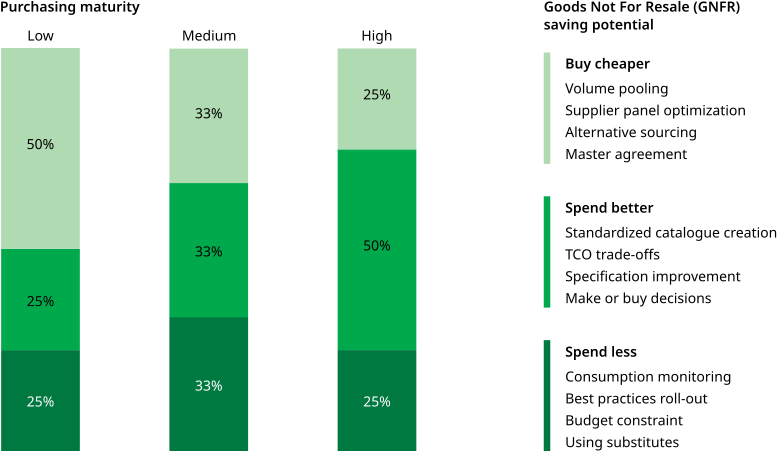
With that kind of approach, our experience indicates, there is potential to reduce indirect spend by 10% to 15% over three years, equating to a total cost reduction of 50 to 100-plus basis points. The value at stake is substantial, but achieving these results requires more than just optimizing procurement transactions through renegotiation or volume pooling. There are three primary strategies for managing indirect spend: buy cheaper, spend better, and spend less. All three must be coordinated for effective optimization.
Exhibit: Three performance macro lever types to be leveraged
Source: Oliver Wyman analysis
Innovative sourcing strategies for cost saving
Many companies focus on reducing costs by purchasing the same products or services at lower prices through enhanced competition, pooled volumes, or renegotiation. While this method often yields quick wins, innovative levers can provide additional savings. For example, some retailers have implemented creative sourcing strategies that leverage low-cost country sourcing alongside their direct import structures.
Optimize spending with total cost and energy efficiency insights
Spending better involves shifting focus from the products purchased to the business needs they fulfill. It also needs to include total-cost-of-ownership (TCO) calculations and consider scenarios for lifetime cost implications. Whether it is cooling systems or automated warehousing, the differences in power efficiency can lead to very different vendor rankings. Spending decisions also depend on the considered time horizon and assumptions on the future evolution of energy costs. Many companies still struggle with the resulting CAPEX/OPEX-trade-off as it is allocated to different budgets.
Reduce consumption with effective cost optimization strategies
Spending less entails reducing consumption volumes, which is conceptually straightforward but challenging to implement. Effective cost optimization requires monitoring consumption, setting rules and policies, and fostering a culture of cost control the organization. Communication programs can help share best practices and raise awareness among employees.
Additional contributors: Charlotte Donoghue, business impact manager, Oliver Wyman. Simone Korrel, engagement manager, Oliver Wyman.

