


Agentic AI pays off only when IT becomes a different function: Domains are co-owned by a business lead and a technology lead, platforms are run as internal products, and controls are approved before deployment and enforced while agents work. But while the bulk of the design and implementation of agentic AI is the responsibility of the CIO and IT function, realizing its full potential depends on pulling levers that are the sole province of the CEO and executive committee (ExCo).
This point of view sets out five decisions the CEO and executive committee must make before agentic AI can be scaled: define the enterprise’s ambition for agentic AI, commit sufficient funding, align workforce plans, name the executive accountable for turning freed capacity into business results, and establish governance. It also offers 10 questions to identify gaps in the organization's readiness to scale agentic AI and a proposed board resolution to formalize the commitments required to advance agentic AI.
Start with the 10 questions, then revisit the answers before confirming the five decisions and seeking board approval.
- What enterprise outcomes must agentic AI deliver?
- Which operating-model changes have we authorized to achieve them?
- Have we funded the platform, data, change, and expected transition costs?
- What spending limits and stop conditions govern the program?
- Do the CIO and CHRO share one workforce plan covering humans and agents?
- How will we develop agent supervisors and protect the junior talent pipeline?
- Which executive owns the redeployment of capacity freed by agents?
- What business outcomes will that redeployment deliver, and how will we measure them?
- What may agents do autonomously, and when is human approval required?
- Can we reconstruct and defend material agent actions using reliable evidence?
Moving beyond pilots requires changes to how IT operates
Moving from pilots to production requires more than a working agent: The enterprise must be able to control its actions, track its costs, and assign accountability. Organizations with agents in production are more likely than those still piloting to have the governance and operating structures needed to support them, rather than relying on the technology alone. That includes an agent registry, a sanctioned developer path, a tamper-evident record of what agents did, a named governance owner, and a transformation cadence with a team able to challenge the line. That kind of comprehensive agentic program exists in only 3% of organizations still piloting and 45% of those that have made it into production. While such a system is inexpensive to install around five agents, retrofitting around 500 can become quite costly.
Organizations in production or at scale report large productivity gains more often than those still piloting. Delivered gains above 20% are reported by only 1% of organizations still piloting, 20% of those in production, and 25% of those at scale. Most companies are on the wrong side of that line: Six out of 10 are still piloting, 6% have scaled, and 53% run five agents or fewer, putting them far away from reaching scale.
In order to realize productivity gains and free up capacity, the CEO and executive committee must first align funding, agree upon workforce plans, and name the executive accountable for redeploying freed capacity. These commitments should be in place before large-scale deployment.
On their largest agentic initiative, CIOs put 72% of the effort into data, process redesign, and change, and 28% into tools and licenses; 74% of CEOs see durable advantage in reengineered processes and the operating model, and 4% in privileged access to a model. And the near-term value is reallocation rather than cost-out: 4% of CEOs expect agentic AI to reduce the IT cost base, while 53% expect the IT cost base to rise as a deliberate investment. Reallocation needs an owner.
Scaling agentic AI requires action beyond the CIO
Among the most important decisions that must be made as agentic AI moves from pilot to production are how the capacity freed up by agents will be redeployed and who in the organization makes that decision. That redeployed capacity represents one of the biggest value-adds from agentic AI — yet, based on our survey, CEOs in more than half (57%) of the responding enterprises expected redeployment without a named executive owner, with only one-third naming an owner of that decision.
But these are the decisions that allow business leaders to scale agentic AI, and CEOs must demand evidence and data, not assurances, about the value being captured. Chief financial officers, who own the run economics, should be able to provide a 24-month case that shows cash, run costs, the impact of the transition’s expected temporary productivity dip, benefit timing, which business unit will realize the benefit and in which profit and loss line, and stop-loss thresholds. The chief human resources officers (CHROs) own the workforce end state. This requires a clear, written plan for humans and agents, with a protected junior pipeline that will produce future supervisors.
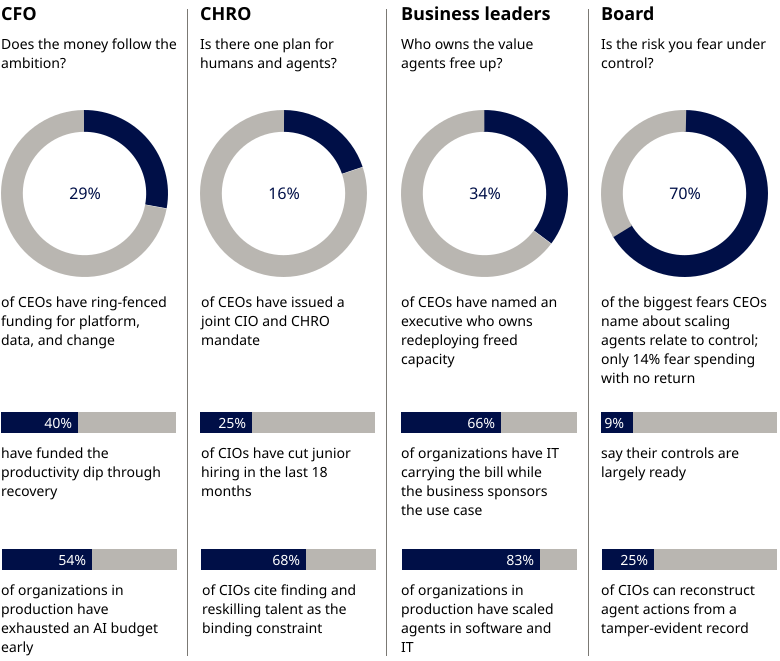
Meanwhile, CEOs and boards of directors must own oversight. Based on our research, only 3% of CEOs are very confident they could reconstruct what an autonomous system did for a customer or in a regulatory matter. That raises questions about whether effective oversight and auditability are in place.
AI investment announcements alone won't impress investors
Another key test is whether an enterprise’s public AI disclosure specifies a plan, capital allocation, and a mechanism for board oversight. The plan should identify the business workflows to be redesigned, the accountable owners, and when benefits are expected. About 40% of S&P 500 companies mention AI in their filings, but only 15% describe any kind of board oversight.
Two peer-reviewed studies of US-listed companies reach similar conclusions: AI disclosures that outline a concrete plan earn a long-term valuation premium, while unsubstantiated claims generate a short-term increase in valuation, followed by sustained underperformance. While 86% of CEOs have committed funding for agentic AI, only 36% have changed a financial target or redirected capital from other projects to fund agentic programs. The executive committee should explain whether agentic priorities require new funding, a shift in existing investment, or revised financial targets.
Performance data should demonstrate whether redeploying freed capacity has reduced costs, increased throughput, or improved service quality relative to a documented baseline. The CEO and executive committee should agree how freed capacity will be redeployed and which outcomes will be measured alongside the CIO’s implementation work and before initiatives are scaled.
Five decisions CEOs must make to scale agentic AI successfully
Five decisions belong with the CEO and executive committee rather than with the technology function. Each addresses a critical execution gap identified in our research.
1. Name it — Make agentic AI an enterprise priority
Leaders must establish agentic AI transformation as a core strategic priority, with two horizons: improving efficiency now and transforming the operating model over time. Only 9% of surveyed companies currently identify agentic transformation as a core strategic priority, highlighting the gap between experimentation and enterprise-wide commitment.
2. Fund it — Commit funding and link investment to financial targets
Ring-fence funding for platforms, data, and organizational change, accounting for the expected productivity dip and subsequent recovery. Investment should be reflected in financial targets, with the chief financial officer overseeing expected gains and controls on spending. Only 29% of surveyed companies have ring-fenced funding, while 50% have committed money without changing financial targets. Just 30% can track consumption by workload.
3. Mandate it — Establish a joint technology and workforce plan
The CIO and CHRO should share a single workforce plan covering employees, AI agents, supervision skills, and the development of junior talent. Currently, only 16% of surveyed companies have issued a joint CIO–CHRO mandate, while 73% manage technology and workforce planning separately. Just 4% of CEO and executive committee respondents identify skill erosion as their biggest concern when scaling agents.
4. Own the value — Assign executive accountability for realizing value
Name the executive responsible for redeploying capacity freed by AI, with business owners agreeing how that capacity will translate into measurable outcomes for each major use case. Our research found that 57% of organizations expect to redeploy capacity without a named owner, while 66% manage spending and value in different profit and loss accounts.
5. Govern at speed — Establish governance that supports speed and control
Enable agents to perform routine actions within approved limits, with named human owners, tamper-evident records, and human approval for changes to controls. Board oversight should respond to significant events rather than rely solely on scheduled reviews. While 84% of surveyed organizations report being on track, only 9% say their controls are ready.
Turn agentic AI strategy into action in these three steps
The following three steps build the evidence, formalize the five decisions, and put them into effect.
First, establish a baseline of current business performance and readiness to scale. During the first four to six weeks of mobilization, before wider production deployment, the CIO, working with business, finance, HR, and risk leaders, should assess strategy, platform, delivery, talent, governance, and run economics. The executive committee should use the assessment to agree which domains to propose for scaling and identify funding needed for remaining prerequisites.
Second, the CEO and executive committee must submit a board resolution authorizing the next phase of scaling, its funding, and named accountabilities. The resolution should lay out the scope, objectives, funding, and named owners, including the executive accountable for redeploying freed capacity, as well as setting the conditions under which the program will continue, change course, or stop.
Third, within 12 weeks of mobilization, the CIO and domain leaders should launch a three-to-six-month delivery cycle in two or three domains. The CEO and executive committee should commit sponsorship through two delivery cycles to cover the expected productivity dip before benefits emerge. Delivery teams should report progress against agreed business outcomes in these domains. If the program’s value case falls below the agreed downside threshold, the executive committee must decide to pause or revise the program.
Scaling agentic AI requires more than deploying technology. The organizations that capture lasting value will be those whose leaders commit the funding, workforce plans, accountability, and governance needed to turn productivity gains into measurable business results.
