


As awareness grows and demand for mental-health services increases, addressing mental health is becoming a national priority in Saudi Arabia. In recent years, authorities have taken important steps to expand access, reduce stigma, and strengthen the foundations of care — embedding mental wellness within Vision 2030 and the Health Sector Transformation Program, expanding services across primary healthcare, and broadening insurance coverage for mental health.
Executing on that ambition will not happen overnight. Gaps remain in access, service delivery models, and system capacity. Turning policy intent into sustained impact now hinges on the workforce — the clinicians, counselors, and support teams who deliver care in hospitals, communities, and workplaces.
The Middle East’s mental health treatment gap is impacting workplaces
According to the Saudi National Mental Health Survey, only 14% of people in the Kingdom who experience a mental health condition seek treatment in a given year. Care remains predominantly hospital-based, even though strengthening community-based services would bring support closer to where needs arise.
These dynamics are felt across workplaces — and not only in Saudi Arabia but across the Middle East. Nearly half of employees in the region report feeling stressed “in everyday life” or “most days at work,” and 37% experience both, according to Mercer Marsh Benefits’ “Health on Demand" study, which included Saudi Arabia and the United Arab Emirates (UAE). It also found that 40% of employees in the Middle East have concerns about their mental, emotional, or cognitive health.

For human resources leaders, the implications are immediate. Mental health concerns among employees affect productivity and retention and signal a clear need to expand clinical services.
Our previous report, “Transforming Mental Wellness," highlighted recurring barriers across the Gulf Cooperation Council (GCC) region, including stigma, low public awareness, limited access and insurance coverage, constrained capacity and infrastructure, weak integration into primary care, insufficient reintegration support, and underdeveloped digital and regulatory foundations.
This article focuses on the mental health workforce and how authorities in the region can begin to close the access gap.
Key workforce constraints limiting Saudi Arabia’s mental health capacity
Saudi Arabia’s ability to expand mental health services is constrained across four key workforce dimensions: overall supply, geographic distribution, training quality, and workload pressures.
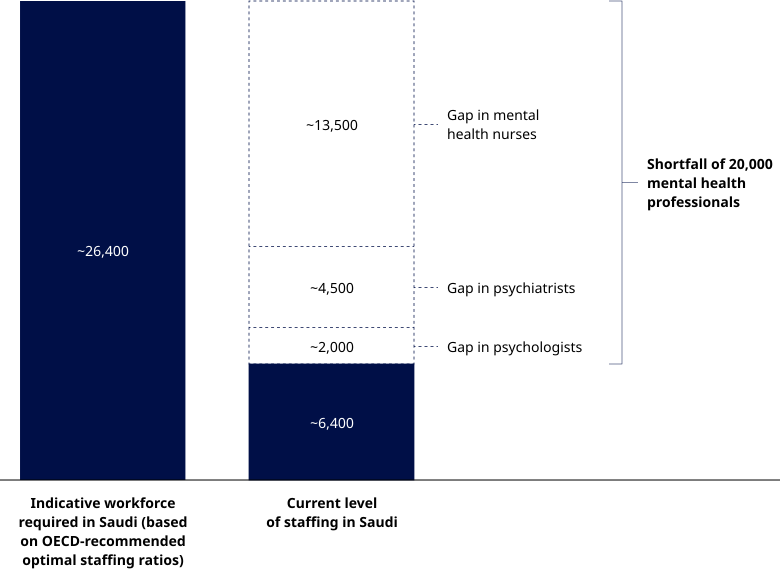
Service distribution: Recent international studies and the Ministry of Health’s Statistical Yearbook indicate that Saudi Arabia has about five psychiatrists, three psychologists, 11 mental health nurses, and three social workers for every 100,000 inhabitants. This is well below the Organization for Economic Co-operation and Development (OECD) benchmarks for high-income countries.
Clinician concentration: More than half of psychiatrists and clinical psychologists work in Riyadh, Makkah, and the Eastern Region, leaving other areas with limited clinician coverage.
Training constraints: The quality of training for nurses, primary healthcare staff, and related social services, is constrained by gaps in supervised practice, especially child and adolescent, perinatal, and geriatric care, as well as limited Arabic-language psychotherapy training and unclear nursing career pathways.
Workload effects: Mental health service providers and administrators often face high caseloads and limited protected time for supervision, alongside cumbersome licensing transitions across public, private, and non-profit sectors. As demand rises, workloads become increasingly unsustainable, heightening the risk of burnout, turnover, and compromised care.
A playbook for robust mental health workforce development in Saudi
To address these challenges, Saudi Arabia needs to quickly expand, upskill, and better deploy its mental health workforce while safeguarding the quality of care. Leaders can close the workforce gap by applying a six-Bs playbook:
Build: Ring-fence mental health tracks in medicine, psychology, and especially nursing. Set up one-year postgraduate conversion programs for general nurses. Codify a national Arabic language curriculum for low intensity talking therapies, with supervised practice, for use in primary healthcare, schools, and large employers.
Bring: Use targeted, fixed-term recruitment to cover near-term gaps, with priority for psychiatry, senior mental health nursing, and child and adolescent specialties. Make training and supervision integral to contracts. Fast-track licensing and deploy clinicians first in areas where coverage is most limited.
Borrow: Stabilize access while local pipelines mature by creating a national roster of locum psychiatrists, telepsychologists, and Arabic-speaking therapists drawing on regional and diaspora talent. Measure against a simple access standard, first appointment within 10 business days, to help providers allocate staff effectively.
Bind: Reduce turnover through a retention ladder, with early awards after three to five years and larger incentives after nine to 12 years. Front-load incentives in hard to staff regions, paired with protected supervision time, funded continuing professional development, and balanced inpatient and community rotations to encourage clinicians to stay and teach.
Boost: Shift the operating model from hospitals to community care by building multidisciplinary teams linked to primary healthcare. Run stepped-care pathways with clear step-up criteria. Upskill primary healthcare physicians, school counsellors, and social workers to deliver brief, protocol-defined care.
Bridge: Extend reach through digital portals as the initial service point, introducing e-referral platforms, self-referral into talking therapies, Arabic digital cognitive behavioral therapy, and blended virtual and in-person services. Start with employers, using workplace portals, to scale quickly.
Saudi Arabia has made mental health a national priority. Healthcare leaders need to act quickly to close the workforce gap. A six-Bs playbook provides the levers needed to galvanize resources, sustain momentum, and measure progress so that the people of Saudi Arabia receive the mental healthcare they deserve.
