


Tariffs have always presented thorny strategic planning issues for manufacturers and retailers. Unprecedented tariff actions and legal rulings in the US and elsewhere over the past several months have heightened the challenges to a new level. The resulting uncertainty threatens to compress profit margins and severely complicate working capital management, especially inventory levels. In an Oliver Wyman Forum survey of CEOs of New York Stock Exchange-listed companies, 89% viewed tariffs and trade policies as a risk to their businesses, up 20 percentage points from 2024.
It's clear that conventional strategies, no matter how reliable historically, are insufficient for navigating this volatile trade environment. Instead, companies must implement a more agile framework focused on the interconnected levers of pricing, inventory, and sourcing — a "strategic triangle" designed to protect their profitability and ensure operational agility both in the near term and for the long haul.
Tariff-driven pricing for speed and innovation
Of the three components of the framework, pricing adjustments are the fastest method for preserving margins in response to tariff-induced cost increases. For context, during the 2018 US-China trade war, prices began to increase between one and three months after the imposition of tariffs. The current tariffs have accelerated the timeline: The Oliver Wyman Forum survey found that 76% of both manufacturers and retailers are now imposing price increases or surcharges more rapidly. Many companies have additionally responded to tariffs by absorbing cost increases (50% of manufacturers and 33% of retailers); finding new US suppliers (37% of manufacturers and 24% of retailers); and scaling down their operations (13% of manufacturers and 15% of retailers).
To keep up with the market environment, however, a business cannot view price adjustments as static, one-off events. Pricing and commercial teams need to be embedded in tariff response management to develop a dynamic, comprehensive pricing plan that continuously evaluates factors including tariff exposure, market positioning, and customer price sensitivities. The organization then has several mechanisms by which to implement the newly optimized prices, such as price book management, account management and negotiation, and customer list segmentation.
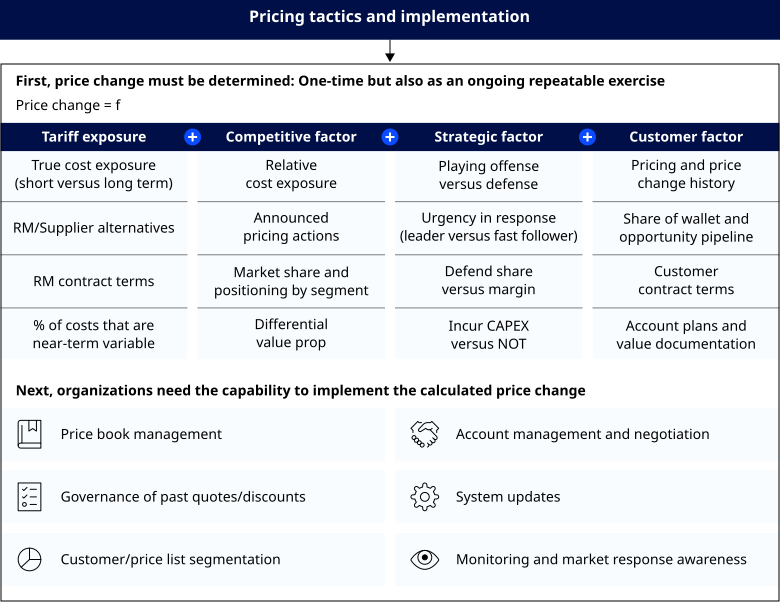
Past periods of macroeconomic stress have given rise to new ways to price, like Amazon’s membership pricing, Unilever’s shrinkflation, and Netflix’s tiering and freemium models. Similarly, the most innovative companies today will view pricing actions as more than simply defensive maneuvers, ultimately creating entirely new pricing models that respond flexibly to changes in the trade and competitive environment while also driving customer loyalty and revenue diversification.
Inventory strategy to protect cash flow under tariff pressure
Inventory comprises 70% or more of the cash conversion cycle for many industries, and the cost of holding excess stock is becoming increasingly expensive. Effective inventory management is vital to preserving cash and maintaining customer fill rates, two goals that companies historically have struggled to achieve during times of great uncertainty.
Amid a climate of fluctuating demand and tariff-induced cost pressures, it is incumbent upon companies to answer strategic questions in several key areas:
- Sales: Do we have the optimal inventory to meet changing customer preferences, such as lower volume due to market slowdown or demand shift?
- Finance: Are we holding the right product mix at strategic locations to keep inventory cost low, without compromising customer service?
- Supply chain: Have we adjusted our inventory stocking and replenishment policies in line with new customer requirements and adjusted supply lead times?
- Manufacturing: Are we able to balance production and supply at the location that minimizes the impact of tariffs?
- Procurement: Do we have the right terms and conditions commitments from our suppliers to account for market volatility that affects, for example, minimum order quantities (MOQs) and supply lead times?
Addressing these questions requires a multi-pronged inventory strategy involving, among other elements, a redesign of the company’s supply chain product flow path, enhanced demand planning to anticipate shifts in consumer preferences, and real-time, granular inventory visibility to track compliance and improvement. Using this approach, one of our clients, a specialty chemical company, improved customer fill rates by 40% and reduced inventory by 25% within nine months, despite a host of volatile conditions.
The China-plus-one sourcing strategy for US firms
US manufacturers and retailers that source from China typically choose from among three approaches to mitigate the effects of tariffs. Each carries both unique advantages and risks.
Moving out of China: Collaborating with existing Chinese suppliers to establish manufacturing operations outside the country allows companies to avoid Chinese tariffs while maintaining relationships and design capabilities. Labor is also significantly cheaper in Southeast Asian countries. However, those savings are offset by low productivity, higher MOQs, and 30- to 60-day increases in lead times. Overall, this strategy increases free on board costs by an average of 15%-20%.
Partnering with new local suppliers in Southeast Asia: This approach also avoids tariffs and has the additional benefit of local supplier costs that are 10%-15% lower on average than for Chinese companies entering the new markets. On the other hand, it comes with the same labor productivity issues endemic to Southeast Asia, along with limited capabilities to develop new and complex products.
Staying in China: Continuing to source within China allows businesses to retain mature supply chains, design capabilities, consolidated shipments, and product certification advantages, but exposes them to 45–60% tariffs, substantially increasing total cost of ownership.
Given the downsides of conventional China-plus-one sourcing strategies, we recommend adopting a hybrid approach that blends cost competitiveness with enhanced flexibility and risk management. First, companies should move high-volume, high-value stocking keeping unites (SKUs) out of China where possible. Higher-complexity SKUs should remain within China due to the capacity limitations in Southeast Asian countries. Any SKUs sitting with suppliers that refuse to move out of China due to their own business risk should be moved to new suppliers.
To further reduce sourcing costs, manufacturers and retailers can identify opportunities to rationalize SKUs to minimize exposure from less critical products. They also should work on codeveloping cost reduction initiatives with Chinese suppliers to offset tariffs.
Tariff strategy for short and long term planning
The contemporary tariff environment demands that companies go beyond traditional reactive stances and proactively innovate across pricing, inventory, and sourcing. Of course, crafting and implementing a full-scale strategy to address tariff uncertainty will take significant time and careful consideration. But there are many important moves that should be made immediately. We’ve outlined a plan of action leveraging the three components that will go a long way toward improving companies’ positioning over just a 90-day period.
Sustaining competitiveness in a shifting tariff landscape
In the longer term, engaging experts and investing in advanced planning and operational tools can accelerate progress and unlock tangible benefits. Specifically, with the right vision and guidance, manufacturers and retailers that adopt the strategic triangle framework will better protect margins, preserve working capital, and sustain competitiveness. Together, the framework’s levers create a continuous cycle of strategy, planning, and execution that helps businesses not only survive, but seize tremendous opportunities in the shifting trade landscape.