


In today's rapidly evolving global landscape, supply chains face persistent structural pressures that extend beyond the shocks of recent years. Our “2026 EU Supply Chain Tech Report,” a collaboration with Prequel Ventures — the leading venture capital fund for supply chain technology startups in Europe — offers critical insights into how leading supply chain executives are navigating these challenges by rethinking technology investments, industrializing artificial intelligence (AI), and collaborating with startups to build adaptable, resilient supply chains.
This report is essential reading for supply chain technology experts, chief procurement officers (CPOs), venture capital funds, and AI professionals seeking to leverage technology for strategic advantage.
From crisis management to cost performance discipline
The past few years have been dominated by global disruptions — from the pandemic to geopolitical tensions — that forced supply chains into crisis mode. Now, the landscape is shifting toward normalizing performance management, with a clear focus on cost discipline rather than short-term resilience.
According to the report, reducing costs has emerged as the top priority for technology investments, outranking innovation or growth objectives. This marks a strategic pivot: companies now view digital and AI not just as tools for innovation but as engines to improve productivity, reduce waste, speed planning, and mitigate operational risks. Technology initiatives are expected to deliver measurable business outcomes, including cost savings, better working capital management, and service improvements, rather than existing for innovation’s sake.
Artificial intelligence — from promise to industrialization
AI, especially generative AI, is becoming the cornerstone of smarter, automated supply chains. While many companies have explored AI through proofs of concept and pilots, widespread operational rollout is limited, with only about 15% having reached full industrialization. The complexity of coordinating AI across multiple supply chain functions — procurement, planning, and logistics — creates structural bottlenecks that slow progress.
The top 15% of companies responding to our global survey of supply chain executives have invested aggressively in AI: They enjoy nearly three times the advantage in technology industrialization compared to the bottom 15%. This gap highlights the competitive edge of early adoption.
Yet, AI adoption faces significant hurdles. The primary challenge cited by two-thirds of respondents is poor and fragmented data quality, closely followed by difficulties integrating new AI tools with legacy systems and siloed applications. AI reveals and exacerbates existing supply chain weaknesses rather than creating new ones. Thus, success with AI depends more on fixing foundational data and integration layers than purely on perfecting AI models. Companies must modernize their data ownership, governance, and architectural discipline before AI can scale to deliver true value.
Board-level discipline for technology and AI investment
The report offers a clear, sequenced agenda that corporate boards should consider to ensure technology investments yield measurable returns. Technology spending must be firmly anchored to cost and productivity goals — it is an enabler, not an objective unto itself. Boards should condition funding on clear links to cost reduction, working capital improvement, service enhancements, or risk mitigation. Data ownership and governance must be formally established before scaling automation or AI, including clear quality standards and service levels.
As modularity increases, architectural discipline is critical. Organizations should simplify their IT landscapes by accelerating cloud and business intelligence adoption, retiring customized legacy systems, and preventing unchecked proliferation of modular tools without integration governance.
AI must be industrialized as part of ongoing business execution — starting with clearly defined business problems, enforcing machine learning operations and accountability, and fostering AI literacy at the board and executive level. Cross-functional "digital operations" teams spanning supply chain, IT, and data should be sponsored to break silos and accelerate initiatives. Boards also must assign clear ownership for AI risk, ethics, privacy, security, and compliance as adoption scales.
The strategic role of startups in supply chain transformation
The European supply chain startup ecosystem remains a crucial innovation engine, especially as investors increasingly concentrate capital in fewer, promising ventures amid a challenging funding environment. Startup founding activity reached a high in 2021, but dropped sharply as funding conditions deteriorated starting in mid-2022. For 2025, the number of newly founded supply chain startups was estimated to be nearly 50% lower than in 2024. However, the average pre-seed and seed round sizes have increased significantly, reflecting concentrated investor confidence.
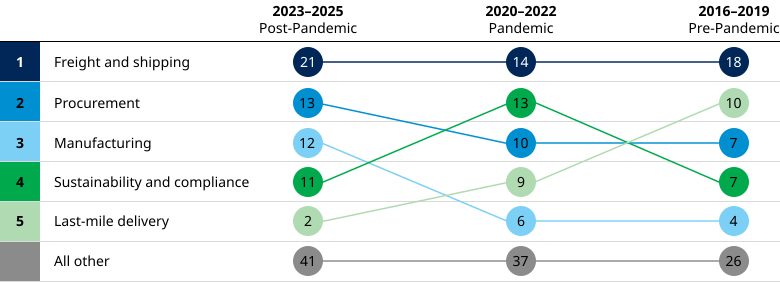
Geographically, Germany leads in supply chain startup activity, followed by the United Kingdom; together, they account for about 80% of new startups. Other established hubs include France, Switzerland, and the Netherlands. Over the past decade, startup focus has evolved from freight, shipping, and last-mile delivery to procurement, sustainability, compliance, and, recently, manufacturing — reflecting regulatory pressures, geopolitical trends, and potential European re-industrialization.
Despite challenges in some segments, such as freight and last-mile delivery, funding for manufacturing, sustainability, and fleet management has surged, signalling where innovation momentum is building. Collaboration between corporations and startups has doubled in the past year, with nearly three-quarters of companies piloting emerging solutions. However, without solid data governance and architectural integration, there is a risk of proliferating fragmented, complex tech stacks. Startups are emerging as agile problem solvers addressing compliance, carbon metrics, resource scheduling, and logistics optimization, underscoring their strategic importance in the supply chain ecosystem.
Why disciplined execution now defines supply chain success
The evolving supply chain landscape increasingly demands disciplined execution from leadership, prioritizing cost and productivity outcomes over unchecked innovation. Success hinges on strengthening foundational data ownership, simplifying architectures, and embedding AI as an integral part of business execution rather than a standalone project. Early-stage pilots must be managed distinctly from scaled delivery, ensuring initiatives either prove measurable value or are halted. Strategic collaboration with startups and disciplined investment will underpin supply chain resilience and agility in the complex, cost-pressured environment ahead.
