


Critical trends and structural shifts are redefining the future of education enrollment. Demographic pressure, policy variations, and changing family preferences are redistributing growth across both early childhood and K-12 education.
As K-12 districts face a multimillion-student decline, charter and private schools continue to see rising enrollments. Public pre-K expansion is reshaping where and how growth happens in the early childhood sector.
While the opportunity for investors and operators remains, it is moving. As K-12 and early childhood education enrollment evolves, investors and management teams must recalibrate their strategies to capture growth and sidestep challenges in this new landscape.
How demographic decline meets school choice for K-12
For public K-12 districts, school enrollment is projected to decline by about 3 million students over the next five years, driven primarily by demographics and amplified by increased interest in and availability of school choice. Both charter and private school enrollments are expected to grow. In addition, declining immigration rates could further affect K-12 district enrollments.
This is new territory for many edtech providers. Many districts will confront additional budget pressures as funding, often linked to enrollment, slows or declines. District leaders will be pushed to prioritize efficiency, professionalization of processes with software, and outsourcing of non-core activities.
At the same time, the charter and private school segments are gaining importance as funding follows students. This will create new competitive dynamics that differ by state. For investors and management teams, charter and private school growth will mean shifting go-to-market approaches and adapting to accelerated procurement cycles in a more fragmented market.
Furthermore, charter schools are expanding market share in over half of the US states, buoyed by rising bipartisan parent demand and favorable policy environments. This growth is uneven across states, making state policy and local demand more important than national averages. It is a clear growth segment amid a declining overall K-12 enrollment market.
Demand rebounds from post-pandemic lows as providers pursue growth
Post the early childhood education sector rebound from pandemic disruptions, private market growth remains muted. Participation among three-to-five-year-olds is inching up. However, flat demographics, modest increases in enrollment propensity, and expanding public pre-K options are limiting market-driven growth opportunities for private center operators.
Public pre-K enrollment share and growth vary significantly by state. States differ significantly in policy priorities, funding, and community demand, creating a wide spectrum of demand levels for private providers. They also differ in whether they deliver public pre-K through districts or choose to rely on subsidies for private providers.
For example, some states are aggressively expanding public pre-K but are content to have these students primarily served by private providers (for example, Florida). Others prefer to serve students themselves, such as in California. These nuances matter not only for private providers but also for the software, curriculum, and services that support them.
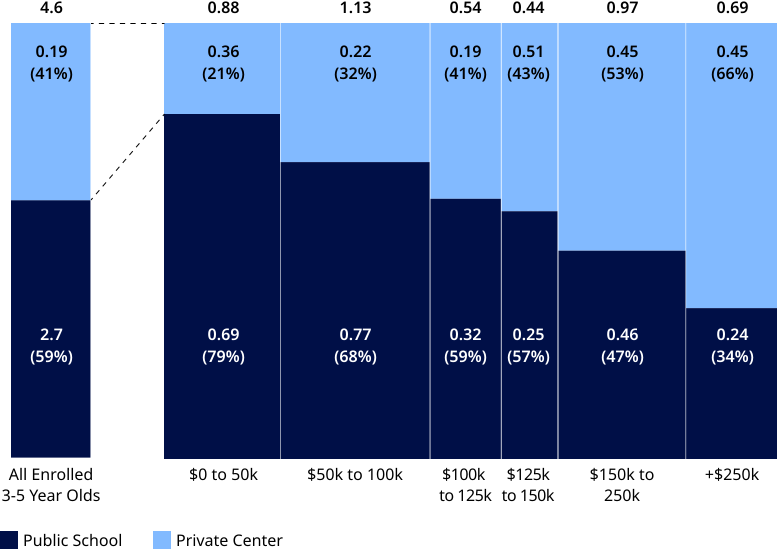
Socioeconomics also plays a part. Private early education enrollment skews heavily toward higher-income families, constraining the addressable market in many local geographies. As a result, private provider growth is closely tied to local income demographics and/or the availability of subsidy programs that can effectively broaden demand.
Go-to-market strategies for a shifting K-12 market
The evolving enrollment landscape demands nuanced strategies for investors and companies in the sector.
For investors, diligence needs to get more local and more granular.
- Early childhood education. The target company’s state footprint, neighborhood income dynamics, and premium positioning matter more than they did five to 10 years ago. A reputation for high quality is paramount as growth will require taking share.
- Funding pressure. Across K-12 and early education, tighter funding (other than in local geographies where enrollments are expanding) will raise the bar for vendors. The most attractive assets will be those serving segments high in the budget priority stack, with access to alternative funding mechanisms and/or demonstrated ability to take share. These factors are becoming — and in some cases remain — very important.
- District competition. As public school districts face more competition for students, providers that help districts attract and retain students, such as those focusing on improving the experience for parents, will become more valuable.
- Growing sub-populations. Despite overall population decline, there are growing sub-populations, such as special education. Market segments that help districts serve these, as well as other sub-groups with specific funding streams, such as career and technical education programs, have more resilient demand and are more attractive areas for investment.
For management teams, value creation will require creating business model resilience.
- Fragmenting student base. As the K-12 student base fragments across district, charter, and private schools, adjustments and investment behind go-to-market approaches will be required, especially for those that have historically focused on district-level sales.
- Targeting high-growth markets. National demographics will be a headwind, but there will be variations by state and metro. Focusing go-to-market efforts on higher-growth districts can drive above-market growth.
- Pricing models under pressure. Pricing architecture will matter more in a declining enrollment environment. Per-student pricing models will be a drag on growth, whereas site-license pricing models are likely to be more resilient to demographic shifts.
- Renewals as a growth engine. As district budgets tighten, renewals and the supporting customer success motion will become even more important in driving performance, as purchasing will face greater scrutiny.
- Shifting early education economics. As public early education enrolls more three-to-five-year-olds, private operators will see their opportunity shift to serving a greater proportion of infants and toddlers, which is less profitable due to higher required staffing ratios. Generating revenue through new avenues, such as after-school care, will become more important, as will optimizing economics through operational excellence (for example, labor) and pricing strategy.
Seizing opportunity in a reset market
The post-pandemic education market is not simply recovering — it is resetting. Across early childhood and K-12 education, shifts in demographics, policies, and family preferences are changing growth patterns and who is best positioned to benefit. The winners will be those who take both a local and national perspective, align with durable funding and demand pockets, and build go-to-market models designed to gain share in a more fragmented, operationally demanding sector.
