
Parts of Asia, like many places globally, face an increasingly dire freshwater shortage. As home to 60% of the world’s population and more than 50% of global crop production, Asia is at a critical juncture in a burgeoning global water crisis that is expected to intensify in the coming years.
Global water demand is set to outpace supply by 40% by 2030, and pressure on limited freshwater in parts of Asia is projected to accelerate over the next 10 years with growth in the population and economic development. At current projected rates of water stress, together with climate change, approximately one billion more people in Asia will become water stressed in the near future.
Agriculture is at the heart of Asia’s water crisis
Agriculture consumes more than 80% of the region’s freshwater and is both the largest driver of water stress and the sector most vulnerable to its impacts. Globally, the region represents more than half of agricultural production and nearly 90% of the world’s rice output. This makes Asia not only a global source of food, but also a major hotspot of embedded “virtual water trade.”
Agricultural production across the region is dominated by water-intensive crops such as rice, wheat, sugarcane, cotton, and alfalfa. Historical diets, cultural preferences, and state-backed subsidies have locked farmers into practices that extract beyond ecological limits. Water-intensive crops are often subsidized, making them economically attractive but ecologically costly. In India, free electricity and procurement support have entrenched rice paddy cultivation in Punjab, where groundwater is being consumed 50% faster than it can be naturally refilled each year.
Given agriculture’s heavy dependence on water, the increased demand for food from Asia’s growing population will exacerbate the already-strained freshwater systems, as will sudden climate shocks such as drought-related disasters and gradual changes in climate. For instance, freshwater reserves such as China’s Yangtze River and the Himalayan foothill rivers are shrinking, aquifers in key agricultural belts are being depleted far faster than they can recharge, and rainfall patterns across the Asia region have undergone notable shifts over the past decade. All these are only adding to Asia’s water crisis, making the supply of water more volatile and less predictable and potentially even damaging crop yields.
Five solutions to mitigate water stress in Asia and improve efficiency
Our report, “The Asia Food Challenge: Achieving Prosperity Through Water Technology And Investment”, produced in collaboration with Temasek and Rabobank, highlights how Asia’s increasing water stress can be mitigated through readily available technologies and practices to improve water use efficiency and reduce water usage.
1. Increasing irrigation efficiency with automated systems
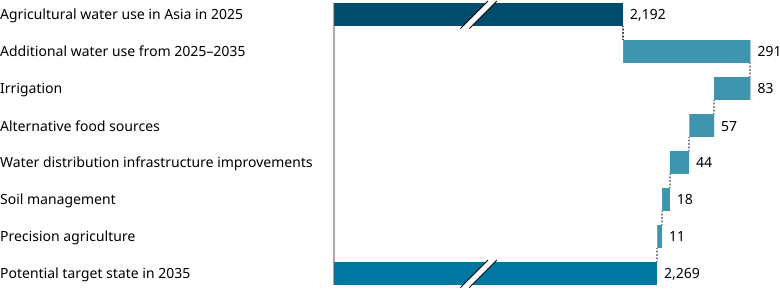
Today, on average, fewer than 10% of farms across Asia use modern systems such as drip or sprinkler irrigation, compared with global adoption rates of about 21%. This solution offers the single largest opportunity. Even a modest increase of WHAT% to close the gap could save an estimated 83 billion cubic meters by 2035, as shown by India’s adoption of automated systems in Karnataka.
2. Exploring alternative food sources and seed innovation
Substituting just 2% of rice, wheat, and maize with water-efficient crops such as millets, and replacing 2% of conventional meat with cultivated or plant-based proteins, could yield approximately 57 billion cubic meters in savings and further reduce demand for water.
3. Improving water distribution infrastructure
Poor or degraded infrastructure results in significant water loss during the conveyance of water from source to field, before the water is even used. By lining 16% of the unlined agricultural canals in Asia, an estimated 44 billion cubic meters of water can be saved.
4. Establishing better soil management practices
Focusing on soil amelioration can regenerate degraded soil, improving water retention and reducing the need for irrigation. Applying these practices to 22% of degraded land in Asia by 2035 could save about 18 billion cubic meters, while also enhancing resilience of the farming land.
5. Utilizing precision agriculture with smart tech
By applying smart technologies such as internet of things sensors, greenhouses, and controlled food-growing environments, about 11 billion cubic meters of water can be saved. China’s Beidahuang Group, for example, deploys smart monitoring across its farms to optimize inputs and reduce waste.
These technologies can further enhance crop yields, with more targeted application of water and nutrients to crops, while also reducing the use of resources like water and fertilizer. Irrigation also allows farmers to be more prepared for climate events, helping them maintain water application to crops and increasing crop yields by 6% to 50%.
Asia’s water crisis demands multistakeholder alignment to drive change
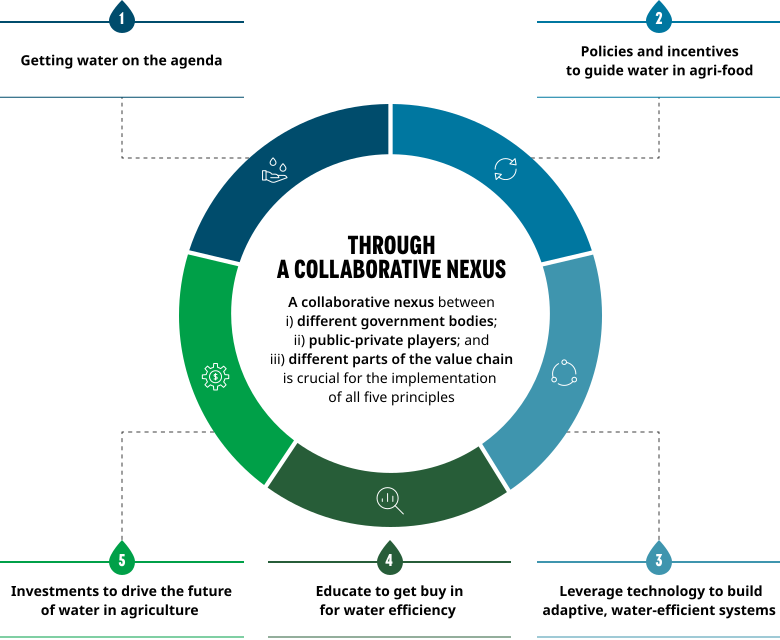
Solving Asia’s agri-food water crisis requires systemic change, not piecemeal fixes. That means every stakeholder must contribute — from governments and investors to industry and farmers. It also requires putting water first in decision making, crafting of policies and incentives that reward efficiency rather than extraction, building and developing infrastructure with the help of technologies, sharing knowledge and educating stakeholders, and investing in water-smart crops and technologies.
Ultimately, the future of Asia’s food security hinges on our collective actions today, while also safeguarding our water resources for the next generations.