


More people are flying than ever before. Across Asia, Latin America, and Africa, a growing middle class is discovering the ease of boarding a plane not as a once-in-a-lifetime event, but as a routine way to get around, and over the next decade, another 200 million people are expected to reach that level of prosperity.
Rising incomes and consumer spending are pushing passenger travel to record levels, fueling the largest year-over-year increase in the in-service fleet since 2008. Air travel demand is outpacing gross domestic product (GDP) growth in most economies, even against the backdrop of global trade tensions and geopolitical uncertainty, and growth in revenue passenger kilometers (RPK) is forecast to be particularly strong in China and India. Airlines are ordering aircraft as fast as manufacturers can build them, and the maintenance, repair, and overhaul (MRO) industry that keeps those planes in the air is racing to staff up.
But the story is more complicated than a simple growth narrative. Supply chain strains, rising operating costs, a looming skilled-labor shortage, and the uneven introduction of new-generation aircraft are complicating the picture. This is what our “Global Fleet and MRO Market Forecast 2019-2029” report examines in detail. Drawing on fleet data and regional traffic trends, it looks at what the next decade holds for the commercial airline fleet and the MRO market that supports it, mapping out where growth is headed and what challenges are likely to cause turbulence.
Record fleet growth is being driven by narrowbody jets from Boeing and Airbus
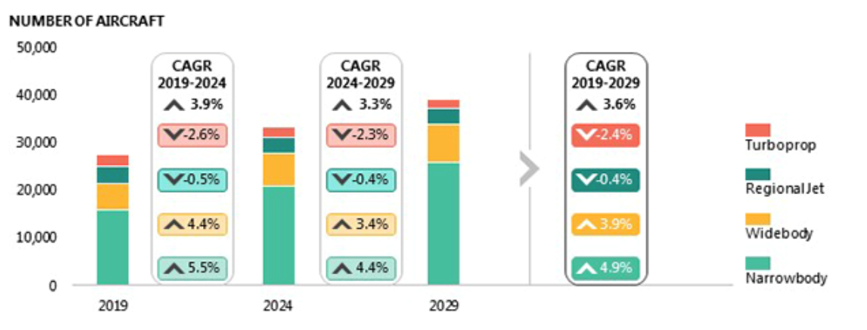
The total global fleet is projected to grow from 27,492 aircraft in 2019 to 39,175 by 2029. Fleet growth will run at 3.9% annually through 2024 before moderating to 3.3% in the second half of the decade. The dominant story is narrowbody jets: Boeing’s 737 MAX and Airbus’s A320neo will together account for nearly 13,800 deliveries by 2029, with narrowbodies reaching 66% of the global fleet. Their extended range, fuel efficiency, and operational flexibility make them the aircraft of choice for low-cost carriers and network operators alike. Widebodies will grow from around 5,500 to 8,000 aircraft, led by the 787 and A350, while regional jets and turboprops face structural decline as narrowbodies absorb their routes.
The MRO market will reach $116 billion by 2029, but growth will be uneven
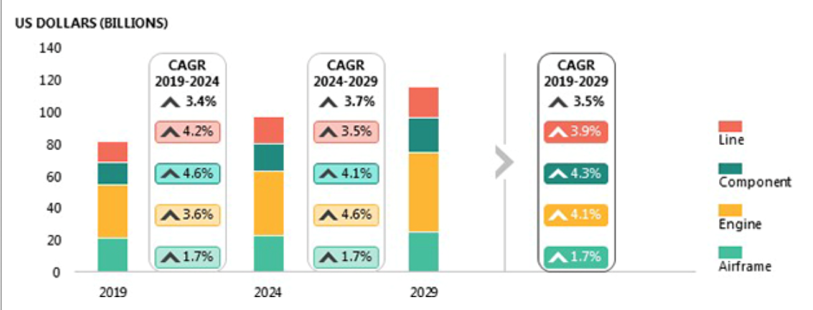
More aircraft means more maintenance, and total MRO spend is projected to rise from $81.9 billion in 2019 to $116 billion by 2029. This growth will also be driven by more expensive maintenance visits and advancements in technology.
We project that the annual average growth rate for the MRO market will be 3.5% over the decade, which will come in two waves. From 2019 to 2024, MRO spend will increase by $15 billion, while the next five years will see it jump to $19 billion, since newer aircraft entering the fleet in the early years are designed with longer intervals between maintenance visits and higher replacement thresholds for life-limited parts.
Five issues will determine aviation industry growth over the next decade
The broad outlook for aviation is positive, with fleet growth and rising passenger numbers. How that growth plays out across the industry will depend on where demand concentrates, whether new aircraft deliver on their economic promise, what happens to smaller aircraft classes, how manufacturers manage their production pipelines, and how the MRO market adapts to a changing fleet.
Asia’s growth will reshape the global fleet and MRO market
Fleet growth will be concentrated in one region above all others: Asia and the developing world. China’s fleet is forecast to grow at nearly 8% annually through 2029, while India is on track for close to 10%.
Besides buying aircraft, China and other Asian nations are investing in new airport infrastructure, domestic manufacturing, and aftermarket MRO services to accommodate the rising demand, much of which will be for domestic travel. Asia is likely to account for the bulk of growth in both the global fleet and MRO expenditures over the decade. By the end of the decade, China will become the biggest global market for air travel, and as a region, Asia is expected to increase its share of the global fleet by almost 9%.
New-generation aircraft will improve airline economics
With new-generation aircraft being 15—20% more fuel efficient, airlines will see real financial and operational benefits as these jets make up a larger share of the global fleet. This will be especially important if fuel prices rise, while fuel efficiency also helps carriers reduce greenhouse gas emissions. Aside from savings on fuel, new-generation jets with advanced technology and sophisticated avionics will provide airlines increased operational flexibility and improved productivity.
Regional jets and turboprops are being squeezed out
Despite multiple new regional jet platforms entering service over the next few years, these aircraft classes will play a much smaller role in the global fleet moving forward, with their share of the global fleet forecast to fall from 13% to 8% by 2029. New-generation narrowbodies are simply more flexible and fuel efficient, making them the first choice for operators across the board.
Delivery delays continue to drive up fuel costs and MRO demand
Delays in new-generation aircraft deliveries prompted airlines to keep older planes in service longer than anticipated, with many operators pulling aircraft out of storage to meet demand. Retirement schedules slowed, and because the newer jets would have been more fuel-efficient and produced fewer greenhouse gas emissions, fuel use was higher than it would otherwise have been. MRO demand also rose to handle the higher servicing needs of older aircraft.
New-generation aircraft will first slow MRO spend, then drive it higher
As the 737 MAX and A320neo enter service and replace older aircraft, global MRO spend will slow in the short term. Equipped with the latest engine technology, these aircraft have longer intervals between shop visits. But when the new technology and life-limited parts do need servicing and replacing, the costs are higher, and MRO spend will rise as a result.